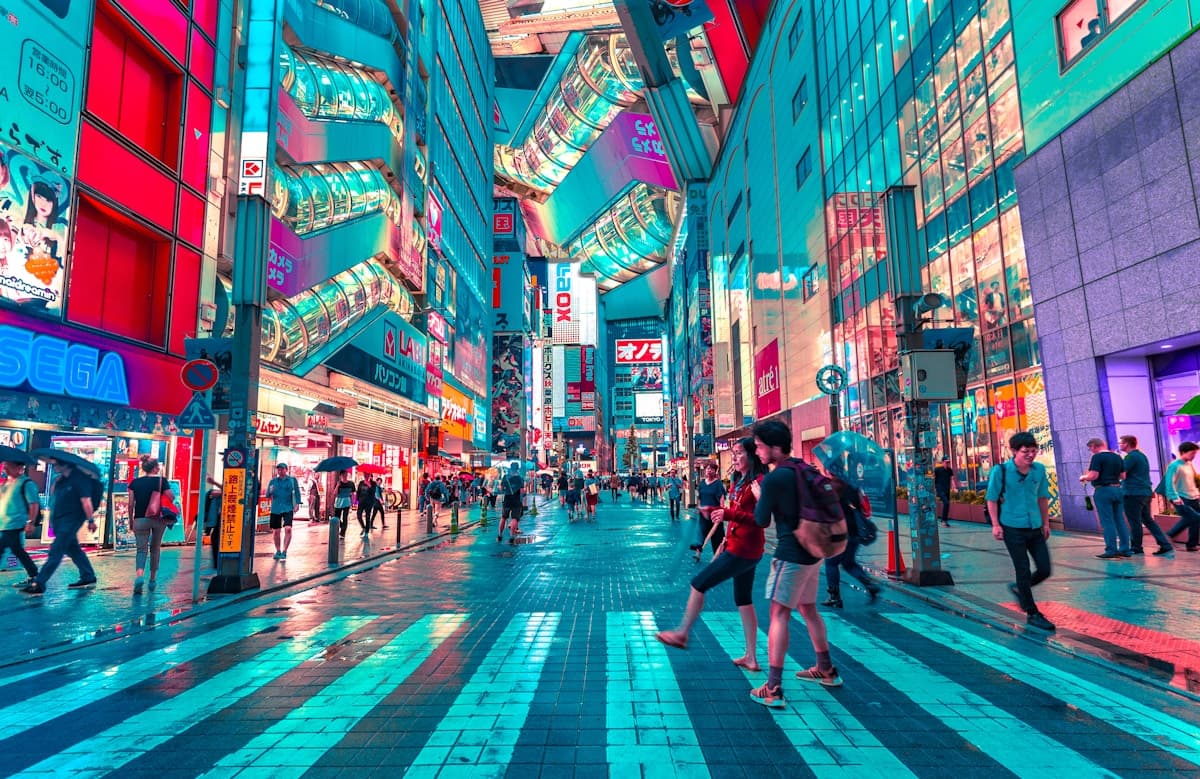
Tokyo
Where tradition and restless energy move side by side.
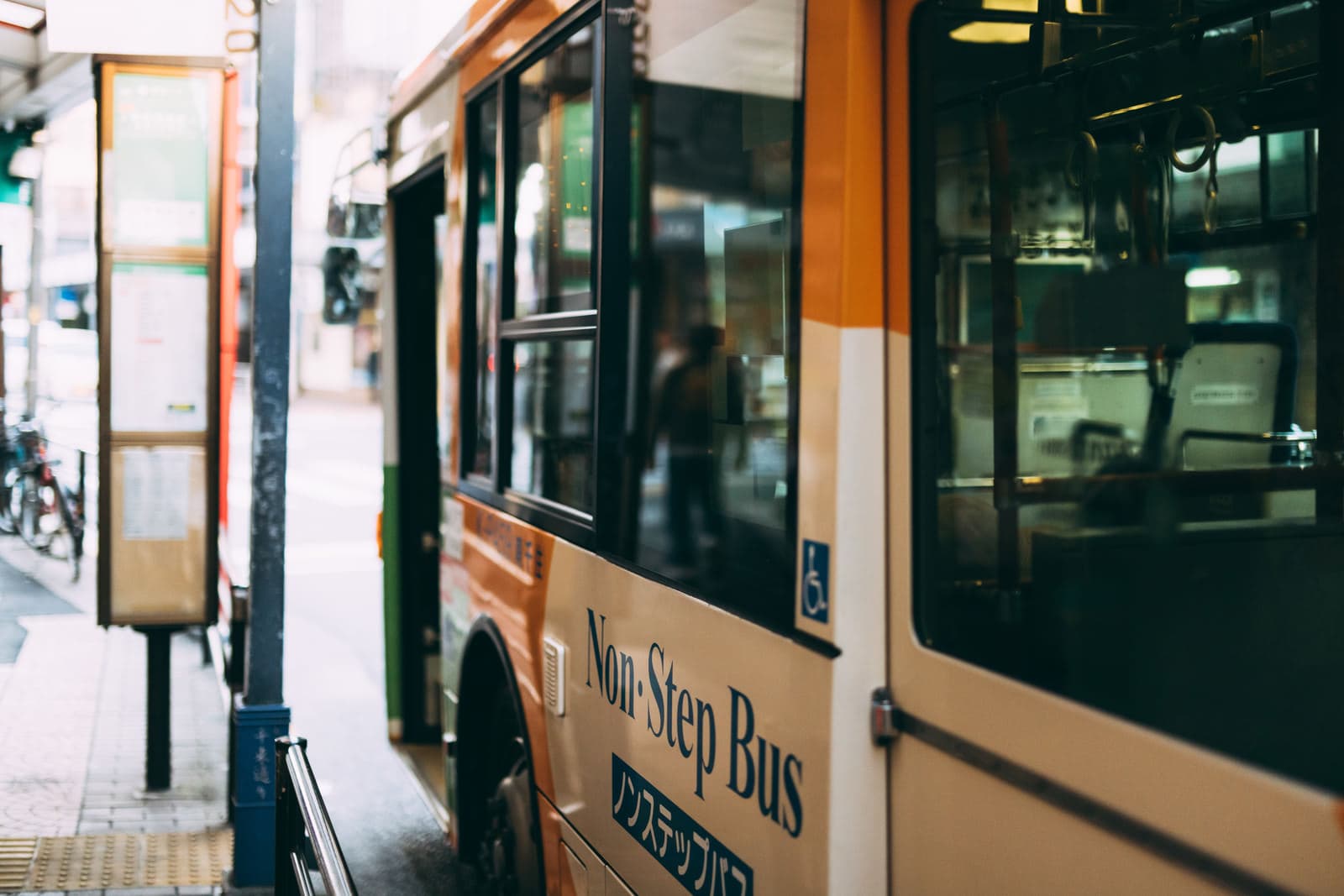
What should you look for when boarding, paying, and getting off a local bus in Japan?
At a city bus stop, two buses arrive within minutes. Both show the same route number. The destination displays differ — one reads Shijo-Kawaramachi, the other Kyoto Station. A first-time visitor who steps onto the wrong one has not failed a test. They missed one readable signal before boarding.
Local buses in Japan are not one national system with one script. They are ordinary city and suburban services whose boarding doors, payment timing, and fare types vary by operator. The work of the first ride is learning what to read on this bus at this stop — not memorizing a rule that applies everywhere.
This article covers one ordinary local journey: confirming the route, finding the right door, paying with an IC card or cash, signaling your stop, and exiting. Airport limousine buses, highway coaches, night buses, and reserved sightseeing services follow different rules — mentioned here only as scope boundaries, not as tutorials.
The goal is calm confidence on the first ride. After that, the bus becomes infrastructure again — like a subway map or an IC tap.
Before you board a local bus in Japan, identify four things on this specific service:
1. The correct stop and direction — route number and destination on the stop sign and the approaching bus. 2. Where to board — front door, rear door, or center door depending on the operator. 3. When payment happens — on boarding or on exiting. 4. How to signal your stop — usually a button before the bus reaches your stop.
In many cities, a flat fare applies and an IC card such as Suica or PASMO works at the reader inside the bus. In other areas — including many rural routes — distance-based fares use a numbered ticket taken at boarding and exact cash paid at the front on exit. IC cards may not work on every rural service.
If the door, reader, or ticket machine location surprises you, pause and watch the next passenger. Procedures vary by city and operator, not by whether you are visiting Japan correctly.
The stop itself gives most of what you need before stepping on.
Route number — confirm the number on the stop sign matches the bus you intend to board.
Direction and destination — buses on the same route number often run in opposite directions or to different terminals. Read the destination display on the front of the approaching bus, not only the route number on the pole.
Stop name — major stops often show names in English as well as Japanese.
Queue discipline — at busy stops, passengers usually line up beside the stop sign. Wait for departing passengers before boarding.
Operator cues — some stops list the bus company. If you are unsure whether this is a flat-fare city bus or a distance-fare route, look for signage about numbered tickets or flat zones before you board.
When in doubt at a quiet stop, show the driver or a nearby passenger your destination written in Japanese or on a map. Asking before boarding is normal on local services.
The same queue-reading habit applies across shared spaces in Japan — see Japanese Etiquette Explained for how to read platform and stop cues before you board.
Japan has no single local-bus procedure because cities built their bus networks independently. What looks inconsistent from a distance is usually two or three repeatable patterns applied by different operators.
The main axes are:
Boarding door — front in many Tokyo services; rear or center on many Kyoto and rural routes.
Payment timing — pay when you board on some flat-fare city buses; pay when you exit on many rear-board services.
Fare type — flat fare within a defined zone in many cities; distance-based fare with a numbered ticket on suburban and rural routes.
IC tap points — one tap at boarding on front-pay buses; tap at boarding and again at exit on some rear-board IC journeys.
Highway coaches, airport limousine buses, night buses, reserved sightseeing express services, hotel shuttles, and ski buses are separate products with their own rules. This article stays with ordinary local and city buses.
The practical habit is to read the bus in front of you — open door, IC reader location, ticket dispenser — rather than assuming the last city’s pattern repeats here.
Two common local-bus patterns — representative examples; operators vary.
| Criteria | Front-board / pay on entry | Rear-board / pay on exit |
|---|---|---|
| Where you board | Front door — Tokyo Toei Bus | Rear or center door — Kyoto City Bus; many cities and rural routes |
| When you pay | On boarding | On exiting |
| IC-card action | One tap at the reader beside the driver when boarding | Tap at boarding; tap again at exit on distance routes — flat-fare routes often tap at exit only |
| Cash action | Coins or ¥1,000 notes into the fare box beside the driver | Numbered ticket at boarding on distance routes; exact fare into the front fare box on exit |
| Fare information | Flat fare — Toei adult ¥210 cash / ¥206 IC | Flat zone adult ¥230 on Kyoto City Bus; distance routes show fare by ticket number on the front screen |
| What to watch for | Destination on front, rear, and side displays; exit through the rear door | Stop button before your stop; next-stop screen at front; exit through the front door |
Where you board
When you pay
IC-card action
Cash action
Fare information
What to watch for
Operators vary. Sightseeing express, airport limousine, and highway buses follow different rules — not covered here.
One journey arc covers most rear-board, pay-at-exit city buses — the pattern common on Kyoto City Bus and many municipal operators. Tokyo Toei Bus reverses the boarding and payment points: front on, pay on boarding, rear off.
The sequence below follows the rear-board pattern. On a front-board service, move the payment step to boarding and swap the exit door — the reading work at the stop stays the same.
1. Confirm route and direction at the stop. 2. Board through the door other passengers use. 3. Tap your IC card or take a numbered ticket if paying cash on a distance route. 4. Ride, watching the next-stop display and listening for announcements. 5. Press the stop button one stop before yours. 6. At the front on exit: tap IC again or pay exact cash, then leave through the front door.
The exact boarding and payment point depends on the operator. If you are unsure, watch one boarding cycle before you join the queue.
Rear-board, pay-at-exit pattern — common in Kyoto and many cities. Tokyo Toei reverses board and pay timing.
Confirm route and direction
Match route number and destination on the stop sign and the approaching bus display.
Queue and watch the door
Board through the door other passengers use — usually rear or center on this pattern.
Tap IC or take a ticket
IC: tap the reader at boarding. Cash on distance routes: take a numbered ticket — one per person.
Ride and follow announcements
Watch the next-stop screen and listen for stop names — often including English.
Press the stop button
Press before your stop; the button lights and a buzzer sounds.
Pay and exit at the front
After the bus stops: IC tap or exact cash at the front fare box, then exit through the front door.
The exact boarding and payment point depends on the operator.
Boarding door is the first signal to read when the bus arrives.
Front-board pattern — representative example: Tokyo Toei Bus. Passengers board at the front door, pay on boarding, and exit through the rear door. Destination displays appear on the front, rear, and side of the bus. This pattern is common among flat-fare city operators in the Tokyo wards served by Toei Bus.
Rear-board pattern — representative example: Kyoto City Bus on most routes. Passengers board at the rear door — or the center door on low-floor buses — and exit through the front door, paying when getting off. The same route family may include flat-fare and distance-fare segments; fare type determines whether you need a numbered ticket.
Low-floor buses may use a center door that sways slightly when opening and closing. Priority seating areas exist on both patterns; mobile phone manner guidance applies near priority seats on Kyoto City Bus services.
Exceptions exist even within one city. Kyoto City Bus sightseeing limited express routes EX100 and EX101 board at the front and pay on boarding — a separate product, not the default city pattern.
If the open door does not match what you expected, step back and watch the next passenger. The door that people use is the correct one on this bus.
IC cards such as Suica, PASMO, and ICOCA work on many city buses across Japan through the nationwide interoperable network — but not on every operator or rural line.
On front-board buses such as Toei Bus, tap the reader beside the driver once when boarding. The fare deducts from your balance immediately on flat-fare services.
On rear-board buses such as Kyoto City Bus, tap the reader at boarding — about one second — and tap again at the front reader when exiting. On flat-fare routes, the exit tap completes payment. On distance-fare routes, the system calculates fare from boarding to alighting. You do not need a numbered ticket when paying by IC on Kyoto City Bus.
Use the same card for the full journey. If balance is insufficient at exit, Kyoto City Bus accepts the remainder in cash with change given.
PASMO guidance notes that bus top-up accepts ¥1,000 bills only, with a balance cap on bus top-up — ask the driver if you need to add value on board.
IC cards do not replace every bus product. Credit and debit cards are not accepted on Kyoto City Bus. The Japan Rail Pass covers JR local bus lines, not municipal city buses such as Kyoto City Bus or Toei Bus.
For card purchase, recharge, and mobile-wallet setup, see IC Cards in Japan. This section covers bus-specific tap points only.
Cash remains useful when IC readers fail, balance runs low, or the route does not accept IC cards.
Flat-fare cash — on rear-board services such as Kyoto City Bus within the flat zone, pay the adult ¥230 or child ¥120 fare into the fare box at the front when exiting. No change is given if you overpay. Use the on-board exchange machine first if you only have larger notes — it accepts ¥1,000 notes and coins, not ¥5,000 or ¥10,000 notes.
Distance-fare cash — common on suburban Kyoto routes and many rural services per JNTO guidance. Take a numbered ticket — 整理券 — from the dispenser at the rear door when boarding, one per person. A screen at the front shows the fare for your ticket number. Pay exact fare into the box beside the driver when exiting. Child fares are half the adult fare rounded up to the nearest ¥10 on Kyoto City Bus. If you did not take a ticket, you pay the fare from the first stop.
Front-board cash — on Toei Bus, put coins or a ¥1,000 note into the fare box beside the driver when boarding.
Exact fare matters on distance routes and on many exit-pay services. Carry ¥100 coins and a few ¥1,000 notes — see Cash or Card in Japan for how much yen to keep accessible and where to break notes at a convenience store.
Local buses announce stops — often in Japanese and English at major cities — and display the next stop on a screen at the front.
Press the stop button before your stop. On Kyoto City Bus, the button lights up and a buzzer sounds when pressed. Other operators follow the same general pattern.
If you miss pressing the button, the bus may not stop. Signal early rather than at the last moment, especially on crowded services.
When unsure, ask the driver or a nearby passenger while the bus is moving slowly or at a red light. Pointing to a map or a written destination is enough at many stops.
Before you stand to exit, move toward the aisle without blocking it. Luggage should not interfere with other passengers — a rule repeated on Kyoto City Bus guidance and worth applying everywhere.
On rear-board services, payment happens at the front after the bus stops. Stay seated until the bus is stationary, then move forward to pay and exit.
Local buses fill gaps trains and subways do not reach — hillside temples, residential neighborhoods, and rural stops without rail access.
A bus often makes sense when:
Your destination sits off the rail network or a long walk from the nearest station.
A flat-fare hop covers a short distance a train would require a transfer to reach.
You are traveling in a rural area where JNTO notes distance-fare buses are the practical option.
The last mile from a station to a specific address is faster by bus than on foot with luggage.
A bus is often not the best default when:
A subway or train covers the same corridor with less road congestion. Kyoto City recommends subway over city bus for Kyoto Station to central and Nishiki — roughly four minutes by Karasuma subway versus congested bus routes.
You are moving between major cities — the Shinkansen or conventional rail handles intercity legs; local buses handle the neighborhood after arrival.
Your schedule is tight and the route is known for traffic delays.
Match the mode to the geography of the day rather than treating the bus as a universal second choice. Planning Less, Seeing More applies when a slow bus leg would compress an otherwise walkable afternoon.
Kyoto is the city most visitors encounter by bus — and the city that most clearly shows why one example is not a national model.
Kyoto City Bus on most routes: board rear, exit front, pay on exit. Flat zone adult fare ¥230, child ¥120. IC cards accepted — ICOCA, Suica, PASMO, PiTaPa. One-day passes exist for mixed bus and subway days. Credit and debit cards are not accepted. Japan Rail Pass is not valid on Kyoto City Bus.
Kyoto City recommends combining trains and buses rather than defaulting to bus-only routes. Subway Karasuma from Kyoto Station to Shijo takes about four minutes; city bus on the same corridor is often congested. For how neighborhood choice shapes those legs, see Where to Stay in Kyoto.
In Tokyo, Toei Bus uses the front-board, pay-on-entry pattern across flat-fare wards — a different rhythm from Kyoto. Base choice in Where to Stay in Tokyo affects how often local buses appear in your daily route.
Other visitor cities — Osaka, Kanazawa, Hiroshima — mix municipal operators with their own boarding and payment customs. Read the first bus you board in each city rather than carrying Kyoto’s rear-door habit into Tokyo or a rural stop.
Sightseeing limited express buses, airport limousine services, and highway coaches are out of scope for this article.
Local buses are narrow aisles and short dwell times — not luggage services.
Kyoto City Bus requires that luggage must not interfere with other passengers. On crowded routes, a large suitcase may be more friction than the bus saves.
Practical approaches:
Store bags at a coin locker before a bus-heavy afternoon if you will return to the same station.
Forward suitcases to the next hotel and ride buses with a day pack only — see luggage forwarding in Japan.
Pack a modest main bag that fits beside your seat rather than blocking the aisle — What to Pack for Japan treats luggage size as a logistics decision, not a checklist.
Kyoto promotes hands-free sightseeing for good reason: Gion slopes and congested bus corridors both punish oversized wheels.
If you must board with a suitcase, keep it upright, hold it steady during stops, and move quickly at your exit so the bus can stay on schedule.
Do I always board at the front?
No. Tokyo Toei Bus boards at the front. Kyoto City Bus on most routes boards at the rear. Rural distance-fare buses often board at the rear or center. Read the open door and follow other passengers.
Do I tap my IC card once or twice?
On front-board flat-fare buses such as Toei, usually once at boarding. On rear-board services such as Kyoto City Bus, tap at boarding and again at exit. Distance-fare IC journeys use both taps to calculate fare.
What is the numbered ticket for?
On distance-fare routes, the numbered ticket records where you boarded. Match the number to the fare on the front screen and pay exact cash at exit — or use IC instead of taking a ticket.
Can I use my Japan Rail Pass on city buses?
The pass covers JR local bus lines operated by JR group companies — not municipal operators such as Kyoto City Bus or Toei Bus. See Is the Japan Rail Pass Worth It? for coverage details.
Can I pay with a credit card?
Not on Kyoto City Bus. Many ordinary city buses accept cash and IC cards only.
What if I do not have exact change?
On many exit-pay buses, use the on-board exchange machine for ¥1,000 notes and coins before paying. Front-board Toei Bus accepts ¥1,000 notes at the fare box.
How do I know when to get off?
Watch the next-stop screen, listen for announcements, and press the stop button before your stop. Ask the driver if unsure.
Can I bring a suitcase on the bus?
Usually yes if it does not block the aisle or disturb other passengers. On crowded visitor routes, forwarding or storing luggage first is often calmer.
Load your IC card with a modest balance before your first bus day — ¥2,000–¥3,000 is enough to start in most cities.
Carry ¥100 coins and one or two ¥1,000 notes even if you plan to pay by IC — exchange machines and fare boxes still expect cash on some legs.
Read the destination display on the approaching bus before you move toward the door.
On rear-board buses, move toward the front early enough to pay before the next stop is called — aisles compress quickly.
In Kyoto, default to subway or train for Kyoto Station to downtown corridors; plan bus legs where rail does not reach.
In Tokyo, remember Toei Bus pays on entry — do not wait until exit to tap.
If a route feels crowded beyond comfort, the next bus or a train alternative may be worth the wait.
Pair bus days with lighter bags — locker, forwarding, or a day pack from What to Pack for Japan.
One successful journey teaches more than reading every operator page in advance.
The first bus ride asks for simultaneous attention: route number, destination, door, reader, ticket machine, stop button, fare box. That concentration is real — and temporary.
Residents do not think about numbered tickets or rear doors as cultural performance. They read the display, follow the queue, and ride. The system was built for daily commuting across operators that sell different products in different cities.
For visitors, the first ride is a calibration exercise. The second ride on the same operator is mostly repetition. The third city may introduce a different door — and the same reading habit still applies.
When the procedure fades into the background, attention returns to the neighborhood you came to see — the market street, the temple lane, the river walk — not to whether you tapped at the right moment.
Load or buy an IC card before you depend on bus readers — see IC Cards in Japan.
Keep some yen coins and ¥1,000 notes accessible for exact fare and exchange machines — see Cash or Card in Japan.
Identify your first bus leg on a map: stop name, route number, and whether subway might serve the same corridor faster.
If staying in Kyoto or Tokyo, read how your neighborhood uses buses — Where to Stay in Kyoto and Where to Stay in Tokyo.
For intercity days, plan Shinkansen or rail first; use buses for the last mile.
If you carry luggage, decide locker, forwarding, or day-pack strategy before boarding a crowded city bus.
Allow unhurried minutes at the first stop. Watching one boarding cycle costs little and prevents boarding the wrong direction.
Taking the bus in Japan is less about mastering a national rule than about reading the bus in front of you: route number, destination, open door, reader or ticket machine, stop button, fare box.
Procedures vary by city and operator. Tokyo Toei and Kyoto City Bus illustrate two common patterns — front-pay and rear-pay — but neither defines every local service in the country. Rural distance-fare routes, suburban lines, and future city guides each add their own readable signals.
The first ride asks the most attention. After one ordinary journey, the bus becomes what it is for residents: infrastructure that moves you the last mile — then steps out of the way so the city can take over.
Continue exploring this way of seeing Japan.
Where tradition and restless energy move side by side.
Where tradition still shapes everyday life.
Where openness, humor, and generosity shape everyday life.