Tokyo
Where tradition and restless energy move side by side.
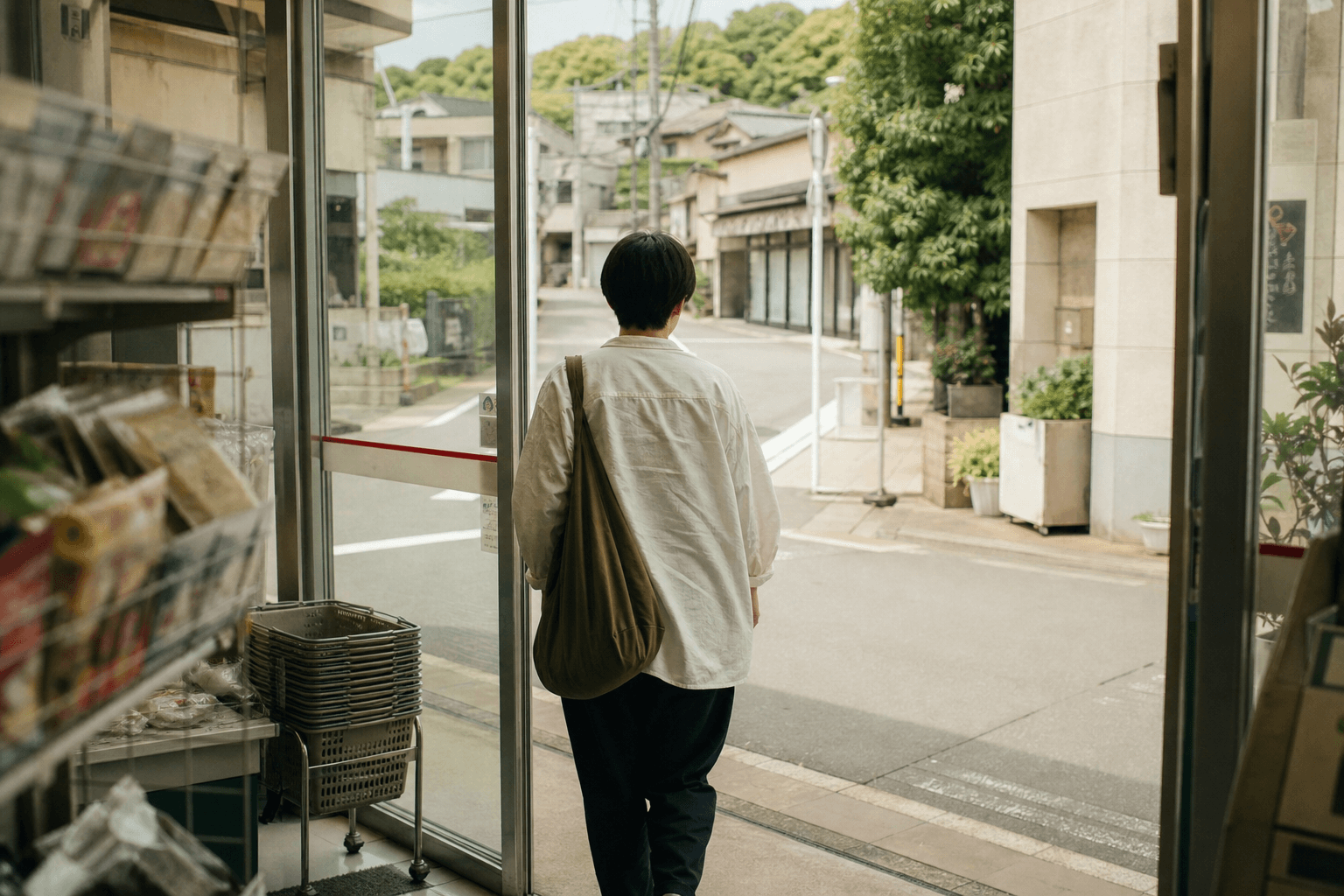
What can a convenience store reliably solve on an ordinary travel day — and what should you not assume?
You leave the station with an hour before hotel check-in. The room is not ready. Your water bottle is empty. Lunch can wait, but something simple would help — a rice ball, a bottle of tea, a place to withdraw cash before the afternoon begins.
A convenience store appears on the next corner. Not as a destination. As infrastructure.
In Japan, these stores are part of how ordinary days move. Residents use them constantly. Travelers tend to notice them only when one problem needs solving before the next train, the next neighborhood, or the next reservation.
The useful question is not which chain is best. It is what a convenience store can reliably do on your kind of day — and what still requires a bank, a hotel desk, or a plan made elsewhere.
A Japanese convenience store is useful because it concentrates everyday solutions in one stop: prepared food and drinks, cash withdrawal at many locations, card and IC-card payment for ordinary purchases, and selected services such as printing, ticket terminals, and parcel counters.
It is not universal. Store hours, ATM brands, terminal equipment, eat-in space, and payment acceptance vary by location. Major chains such as 7-Eleven, FamilyMart, and Lawson share a similar role in daily life, but you should treat each store as its own branch — not as a guarantee.
For travelers, the calmest approach is practical: use a convenience store for small, immediate needs between destinations. Link out for full payment strategy, IC-card setup, and hotel-to-hotel luggage forwarding rather than expecting one shop to replace those systems.
What a convenience store can usually help with — and what still varies by store.
Treat the store as useful infrastructure, not as a complete travel service center.
Think in categories, not in souvenirs.
Convenience stores reliably stock everyday items travelers actually need between appointments:
Onigiri and rice-based snacks. Sandwiches and packaged bread. Prepared meals and bento boxes. Salads and ready-to-eat chilled items. Hot snacks at heated counters in many stores. Hot coffee and other in-store prepared drinks at many locations. Packaged beverages, snacks, and basic groceries. Toiletries, tissues, umbrellas, phone cables, and other small travel supplies at many branches.
Alcohol and cigarettes are sold at most major-chain stores, with age verification at the register. Drinking alcohol under age 20 is prohibited in Japan by law.
This is not a food pilgrimage. You do not need to hunt for limited-edition items or build an itinerary around what is on the shelf. The value is ordinary: a meal when you are between hotels, water when you are walking, bandages when you misjudged your shoes.
Product selection changes by season, region, and delivery schedule. If something is sold out after a busy evening, that is normal operations — not a failure of the store.
For most routine purchases — a drink, a rice ball, a snack, a packaged meal — payment is straightforward.
Cash in Japanese yen is always relevant. Major chains widely accept international credit cards for ordinary goods. Transport IC cards such as Suica and PASMO also work at many registers for many items.
At the register, you usually choose how you are paying before the transaction completes. Staff may prompt you in Japanese; pointing to your card or holding your IC card near the reader is often enough for the basic purchase.
Important boundaries:
Some stores may not accept every payment method. Credit cards often cannot be used for stamps, some tickets and vouchers, utility-bill payments, and certain terminal services. Transport IC cards cannot be used for every purchase type. At 7-Eleven, for example, IC payment does not cover utility collections, some prepaid products, postage, and multi-copy machine services.
If you are still building your payment setup, see Cash or Card in Japan for how much yen to carry and where cards still fail. For IC-card setup, recharge, and daily rhythm, see IC Cards in Japan. This article assumes you may use all three — cash, card, and IC — but does not replace those guides.
A typical in-store purchase follows one calm sequence.
Choose your items
Pick packaged food, drinks, or supplies from the shelves or hot-food counter.
Go to the register
Queue if needed. Place items on the counter or hand them to staff.
Select payment type
Choose cash, credit card, or transport IC card on the register screen when prompted.
Complete payment
Pay in yen, tap or insert your card, or hold your IC card to the reader.
Ask for what the meal needs
Request heating, chopsticks, a spoon, or a bag if useful. Staff may ask you directly.
Terminal services, parcel counters, and tax-free purchases follow separate workflows.
Many travelers first enter a convenience store for cash, not food.
Major chains often host ATMs, but the machine brand matters. Seven Bank ATMs in 7-Eleven are the most consistently documented option for overseas-issued credit and cash cards, with multilingual ATM screens. FamilyMart tourist guidance documents E-net and Japan Post Bank ATMs at participating stores. Lawson documents 24-hour yen withdrawal at Lawson ATMs with overseas-issued Visa, Mastercard, JCB, and UnionPay at stores that have them.
Practical expectations:
Not every branch has an ATM. Accepted card brands and screen languages vary by machine. ATMs may be unavailable during maintenance. Fees depend on your card issuer and the machine operator.
JNTO still advises carrying some cash in Japan. A convenience store ATM can refill your wallet between destinations, but it should be one layer in a broader plan — not your only source of yen.
For how much cash to carry and when cards are safer, see Cash or Card in Japan.
Prepared food is the most common traveler use case — not because the food is famous, but because it is there when the day has no scheduled meal.
Most major-chain stores stock onigiri, sandwiches, salads, bento boxes, and chilled ready-to-eat items. Many also sell hot snacks and in-store coffee or latte drinks.
Heating:
At many 7-Eleven stores, staff can heat food in a microwave on request. Some items cannot be heated in-store. At Lawson, many bento-style items can be microwaved; package labels indicate heating times. Staff may ask at the register whether you want a bento heated.
Cutlery:
For bento, salads, and other ready-to-eat items, ask for chopsticks, a spoon, or a fork when you pay. Staff may ask automatically.
Eat-in space:
Some 7-Eleven stores offer a small eat-in area. If you consume certain reduced-tax food items there, a higher tax rate may apply. Dispose of rubbish according to store rules. Avoid long stays and loud conversation.
Do not treat the shelf as a restaurant menu to optimize. Choose what fits the hour and your appetite. The point is to continue the day, not to evaluate the store.
Beyond the register, many convenience stores host self-service terminals.
Typical uses include:
Printing or copying documents. Purchasing tickets for events, buses, or attractions at some locations. Completing steps for parcel services. Paying certain bills or using other administrative services.
The machine type depends on the chain. 7-Eleven and FamilyMart commonly use multi-copy machines. Lawson uses Loppi terminals. Language support exists on some machines — FamilyMart's tourist page notes multilingual display options for ticket and print services — but you should expect a self-service workflow, not staff-led booking.
Credit cards often cannot be used for some terminal purchases or bill payments even when the same card works for food at the register. Read the on-screen instructions carefully and keep cash as a fallback.
If you only need a paper copy of a boarding pass or hotel address, these machines can save a trip to a business center. If you need complex ticketing advice, a station counter or official booking site may still be clearer.
Convenience stores can help with certain parcel tasks. They do not replace hotel-to-hotel luggage forwarding.
Sending:
Many major-chain stores act as Yamato Transport counters. 7-Eleven can send parcels to airports, hotels, or private addresses when the recipient can receive delivery. FamilyMart uses a multi-copy machine workflow for many send services: complete the application step at the machine, then bring the printed voucher and parcel to the register within the stated time window.
Receiving:
Do not assume you can ship luggage to a convenience store for general tourist pickup. 7-Eleven explicitly states that delivery to a store for pickup is not available because staff cannot receive or store packages on behalf of customers. FamilyMart operates separate EC receive services with their own registration and authentication steps.
Timing:
When sending to a hotel or airport, allow at least one day or more depending on route. Sending in advance is safer than expecting same-day arrival.
For hotel-to-hotel forwarding, cutoff times, and when forwarding beats carrying bags, see How to Use Luggage Forwarding in Japan. Use a convenience store parcel counter when a single send fits your day — not when you need a full forwarding strategy.
These are the details travelers most often overestimate.
Toilets:
Do not count on public customer toilets at every convenience store. Availability varies by branch, layout, and local policy. If you need a restroom, a station, department store, or larger public facility may be more reliable — see Using Public Toilets in Japan for where to look and what to expect once you arrive.
Seating:
Some stores have small eat-in areas. Most do not function as a quiet lounge for long rests. Use them briefly and move on.
Wi-Fi:
Some Lawson stores offer free Wi-Fi with registration and usage limits. Availability is not universal across all chains or branches. Do not plan your connectivity around store Wi-Fi alone. See eSIM vs Pocket Wi-Fi in Japan for a fuller connection strategy.
Rubbish:
Japan has few public bins on streets. Some eat-in stores allow disposal according to posted rules. Carrying a small bag for wrappers until you reach a proper bin is still normal traveler behavior. For when to dispose, where smoking areas begin, and how shared-space cues vary by city, see Japanese Etiquette Explained.
The store solves small needs. It is not a substitute for station facilities, hotel lobbies, or planned connectivity.
In cities, convenience stores often remain one of the few practical options after restaurants close — for food, drinks, ATMs, and small supplies.
That usefulness depends on the branch still being open. Many stores operate late or around the clock, but franchise agreements at major chains allow shorter hours in some locations. FamilyMart store listings show examples ranging from true 24-hour operation to limited daily windows and Sunday-only shortened hours. Lawson's tourist page describes 24-hour operation as a chain model while individual tax-free store listings show varied hours.
Outside major cities, stores may close earlier, carry narrower stock, and host fewer services. An ATM, ticket terminal, or parcel counter you used in Tokyo may not exist at a rural branch.
Before a late arrival or early departure, check the specific store on the chain's store finder rather than assuming city-center hours.
Assuming every store is open 24 hours.
Walking in expecting a public toilet.
Using a credit card for terminal tickets or bill payments without checking exclusions.
Tapping an IC card without confirming the purchase type is eligible.
Expecting to receive forwarded luggage at a store counter.
Treating the visit as a product tour rather than a quick errand.
Blocking a terminal while figuring out the workflow during a busy period.
Opening tax-free consumable bags before leaving Japan.
Relying on store Wi-Fi as your only connection.
Choosing a store far from your route because an online list called it interesting.
Forgetting that staff are managing many small tasks at once — clarity and patience matter.
Use a convenience store when one small need appears between destinations — not as a scheduled attraction.
When restaurants are closed or you only need a quick meal between trains, a konbini can replace a sit-down stop — see Japanese Restaurants Explained for when a restaurant format fits better.
Check store hours and ATM icons on the chain's store finder before a late-night arrival.
Carry cash as backup even when you plan to pay by card or IC card.
Ask for heating, chopsticks, or a bag at the register rather than assuming they are automatic.
Keep passport ready if you use tax-free shopping at an eligible branch.
Photograph terminal receipts and parcel vouchers immediately.
Allow extra time the first time you use a multi-copy machine or Loppi terminal.
Pair IC-card taps with the fuller setup in IC Cards in Japan.
Pair ATM withdrawals with the broader payment mix in Cash or Card in Japan.
For hotel-to-hotel movement, compare konbini parcel send with luggage forwarding before checkout day.
In dense cities such as Tokyo, Osaka, and Kyoto, stores are easy to find. In quieter regions, plan earlier rather than expecting the same service density.
Residents do not visit convenience stores to admire them. They visit because the day contains a small gap — between work and home, between errands, between one obligation and the next.
Travel days contain the same gaps. A room not ready. A train not yet departing. A wallet low on coins. A bottle empty. A printout missing.
The store works when it disappears into the rhythm: you enter, solve one problem, and continue toward the part of the journey that actually matters. That is the correct relationship. Not discovery for its own sake. Infrastructure, used briefly, then left behind.
Expect convenience stores to appear often in cities. Do not build an itinerary around them.
Plan payment in layers: IC card for small urban taps, card where accepted, cash for gaps — using the dedicated guides rather than guessing at the register.
Identify whether your arrival neighborhood has a late-open branch if you land after restaurants close.
Download offline maps and hotel addresses so a store stop is optional, not desperate.
If you may send a parcel from a store, confirm recipient details and timing before checkout day.
Leave room in the day for ordinary stops, as Planning Less, Seeing More suggests — not every hour needs a landmark.
A Japanese convenience store is useful not because it contains everything, but because many small travel needs can be solved in one familiar place.
Buy the rice ball. Withdraw the cash. Print the page. Send the parcel. Then return to the journey you were already on.
The best visit is the one you barely remember — a quiet stop between the station and the hotel, between one neighborhood and the next, between problems that would have been larger if the store had not been there.
Continue exploring this way of seeing Japan.