Tokyo
Where tradition and restless energy move side by side.
Do you need an IC card, and which kind makes everyday travel simpler?
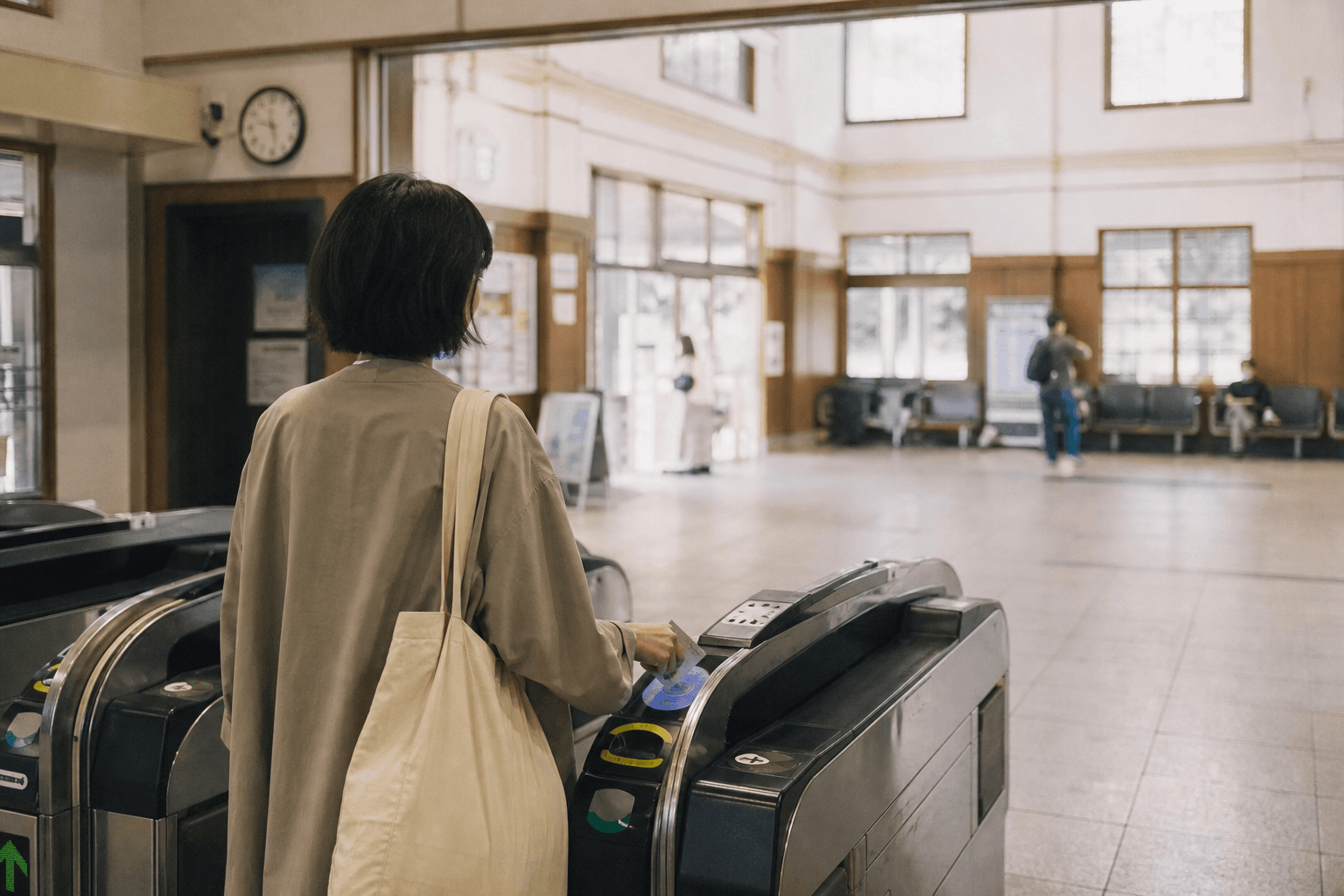
At a station gate, a traveler taps a small card and hears a short confirmation tone. The barrier opens. No ticket is printed. No coins are counted. On the platform, the same card may pay for a drink from a vending machine minutes later.
This is what an IC card does in practice. It does not unlock unlimited travel. It stores prepaid value and deducts the correct fare when you tap in and tap out, or when you pay at a shop that accepts the card.
For many visitors, the value is not a large discount. It is rhythm — removing repeated small decisions from a day that already asks for attention: which ticket, which machine, which line, which amount of change.
An IC card is prepaid travel money on a card or phone: tap in, tap out, and the fare is deducted automatically — no ticket, no counting change.
Suica, PASMO, and ICOCA work the same way for a traveler. Pick whichever is easiest to buy where you land — Suica or PASMO for a Tokyo arrival, ICOCA for Osaka or Kyoto — then use it across Japan's interoperable IC network, with some line exceptions.
Buy and charge one at station machines, ticket counters, or airport counters, mostly with cash; a mobile version in Apple Wallet works too if your device and payment card are eligible.
It covers trains, subways, most city buses, and tap-to-pay at convenience stores, vending machines, and many shops — but not Shinkansen reserved seats, highway buses, every rural line, or continuous travel across some regional boundaries without exiting first.
It will not get you a large fare discount. What it buys is rhythm: one card instead of a new decision at every gate.
You do not need one to visit Japan. But if you plan to move independently through cities by train, subway, or bus, an IC card usually simplifies the trip.
An IC card helps most when:
You will use urban trains, subways, or buses in Tokyo, Osaka, Kyoto, or other major cities. You will change between operators and do not want a separate ticket for each leg. You expect small daily purchases at convenience stores, vending machines, or coin lockers. You are also using a Japan Rail Pass for long-distance JR travel but still need local transport at each stop.
It may be less useful when:
Your tour includes all transport. You are traveling mainly by rental car. Your stay is very short with only one or two manual ticket purchases. You are in areas with limited IC acceptance.
Choose based on how you will actually move, not because the card is treated as a symbol of traveling correctly in Japan.
An IC card is prepaid electronic money, usually on a contactless card or phone wallet. It is not a pass that grants unlimited travel for a set period.
When you tap at a train gate, the system records your entry. When you tap out, it calculates the fare and deducts it from your balance. On buses and at shops, a single tap may complete the payment.
Major IC cards in Japan participate in a nationwide mutual-use network. Suica, PASMO, ICOCA, and other cards with the nationwide IC mark can be used in many regions — but not on every line, and not for every type of service.
Think of the card as a small stored balance you refill as needed, not as a replacement for long-distance ticket planning.
Suica is issued by JR East. PASMO is issued by PASMO Association member railways and bus operators, centered on the Tokyo area. ICOCA is issued by JR West, centered on the Kansai area. For most visitors, all three function similarly once loaded.
According to PASMO's official visitor guidance, Suica, PASMO, Kitaca, manaca, TOICA, ICOCA, Hayakaken, nimoca, and SUGOCA can be used in PASMO and Suica areas, with some line exceptions. PiTaPa is not part of the nationwide electronic-money mutual-use system.
Regional cards matter mainly at purchase and refund. ICOCA is common in Osaka and Kyoto. Kitaca serves Hokkaido. TOICA, manaca, and others serve their home regions but often work in Tokyo through interoperability.
Choosing one: pick Suica or PASMO for a Tokyo arrival, or ICOCA for an Osaka or Kyoto arrival — whichever is easiest to buy where you land. You do not need more than one.
Physical IC card:
Works without depending on phone battery or wallet app availability. Each traveler normally needs their own card. One card should not be shared between two people passing through the same gate. Regular Suica and PASMO include a ¥500 deposit (refundable when the card is returned under operator rules). May involve refund processing at specific operator locations.
Mobile IC card (Apple Wallet):
Convenient for balance checks, top-ups, and carrying one less physical object. Apple Support lists Suica, PASMO, ICOCA, and TOICA as addable transit cards in Apple Wallet on supported iPhone and Apple Watch models with an eligible payment card in Wallet. Foreign-issued payment cards may work for some users, but compatibility varies by card network, issuer, and whether you are inside Japan. JR East notes that Welcome Suica Mobile app download and top-up may be restricted by law in some countries until after arrival. Device loss, battery depletion, or wallet errors can interrupt travel until resolved.
For Android and other non-Apple devices, mobile options for visitors depend on issuer, region, and app availability.
Both store prepaid value. The practical difference is often reliability and refund path.
| Criteria | Physical card | Mobile IC card |
|---|---|---|
| Best for | Travelers who want a simple object independent of phone battery | Travelers comfortable relying on a supported phone wallet |
| Deposit | ¥500 on regular Suica and PASMO | No separate deposit on the card object itself |
| Sharing | One card per traveler at gates | One wallet card per traveler at gates |
| Refund | Return card at issuing operator under published rules | Wallet removal and operator rules differ from physical return |
| Risk | Card loss is separate from phone failure | Battery loss, device loss, or wallet errors can interrupt travel |
Best for
Deposit
Sharing
Refund
Risk
Verify device, payment card, and operator compatibility before you depend on a mobile card abroad.
Visitor-specific cards trade refund flexibility for simpler purchase rules.
Welcome Suica (JR East): No deposit. Valid for 28 days from date of purchase. Sold at JR EAST Travel Service Centers, Welcome Suica vending machines, JAPAN RAIL CAFÉ, and TAKANAWA GATEWAY Travel Service Center — including Narita and Haneda airport stations from March 27, 2025. Prices: ¥1,000–¥10,000. One card per person in principle. Remaining balance is not refundable under standard rules. Top-up by cash only; maximum balance ¥20,000.
TOURIST PASMO (PASMO): No deposit. Valid for 28 days from date of purchase. Sold at Haneda and Narita airports through Keikyu and Keisei channels; prices vary by location (for example, ¥2,000 at Narita Keisei centers; ¥1,000–¥10,000 at Haneda Keikyu machines, per official PASMO guidance). Remaining balance is not refundable. Credit cards accepted at some airport machines.
PASMO PASSPORT: Discontinued. PASMO officially abolished PASMO PASSPORT rules in October 2024. Do not plan around it.
Regular non-personalized Suica and PASMO cards resumed sales on March 1, 2025, after earlier suspensions. Availability at individual stations can still vary.
Common purchase points:
Airports: Narita and Haneda for Welcome Suica, TOURIST PASMO, and some regular cards. Major stations in Tokyo: JR EAST Travel Service Centers and participating ticket machines. Regional hubs: ICOCA machines and counters in Kansai; Kitaca in Hokkaido.
Purchase methods:
Ticket vending machines at participating railways. Station ticket counters (Midori-no-madoguchi and operator counters). Airport information centers for tourist card products.
Regular Suica and PASMO machine purchases are cash-based at issue. PASMO's official purchase guidance states credit cards are not accepted for standard PASMO purchase procedures at counters. Tourist airport machines may accept credit cards where officially indicated.
If you use Apple Wallet, you can also add a new Suica, PASMO, ICOCA, or TOICA card digitally on a supported device, subject to eligibility rules on Apple Support.
Many travelers buy or load a card in the arrival lobby after customs — that timing fits naturally into the sequence in Airport Arrival Guide: Your First Hours in Japan, though purchasing at your first city station remains fine if the arrival hall is crowded.
Top-up methods (operator rules differ):
Station ticket machines and fare adjustment machines displaying the nationwide mutual-use mark. Convenience stores and some shops for participating cards. Seven Bank ATMs for Welcome Suica (cash). Apple Wallet for mobile Suica/PASMO/ICOCA where supported.
Regular Suica: Top-up in ¥500–¥10,000 increments at machines; maximum balance ¥20,000; cash only at machines per JR East. Credit cards cannot be used to top up physical Suica at machines.
Welcome Suica: Cash only for top-up; maximum balance ¥20,000 during validity.
PASMO: Maximum balance ¥20,000 at stations; bus top-up limits differ (for example, TOURIST PASMO bus top-up cannot exceed ¥10,001 on bus per PASMO).
Check balance:
Gate display after tap. Ticket machine balance inquiry. Mobile wallet card screen. Receipt after top-up.
Start with a modest balance — ¥2,000–¥3,000 — and recharge as your pattern becomes clear.
Trains and subways:
Tap the same card at entry and exit. The fare is calculated automatically. If balance is insufficient, use a fare adjustment machine before exiting. Do not tap two different cards or wallets near the reader. Remove the card from a thick wallet or phone case if the gate fails to read it.
Buses:
Procedures vary by city and operator. Some buses require tap on boarding only, others on exiting only, and others on both. In Tokyo-area PASMO guidance, tap the reader inside the bus. Elsewhere, watch passengers or check operator signage. For boarding doors, payment timing, numbered tickets, and stop buttons on local city buses, see Taking the Bus in Japan.
If a gate rejects your card:
Step aside and try again with the card flat against the reader. Check balance. If the problem persists, use the staffed gate and ask station staff. Unfinished entry-exit records can cause later gate errors and should be corrected promptly.
Limited express, Green Car, and reserved services require appropriate tickets in addition to IC card use where applicable.
The same card carries you from purchase through daily movement.
Get a card
Buy a physical or mobile card where your arrival route makes purchase practical.
Charge it
Load value at machines, counters, convenience stores, or a supported wallet.
Tap in
Use the same card at the entry gate or reader.
Travel
Stay on one card for the full journey; adjust fare before exiting if needed.
Tap out
Complete the exit tap so the fare records correctly.
Recharge as needed
Top up when balance runs low rather than loading more than you can use.
Beyond transport, IC cards commonly work at:
Convenience stores and some supermarkets. Vending machines. Coin lockers — the card acts as key and payment on many models; see Using Coin Lockers in Japan. Selected restaurants and shops displaying IC payment marks. Some station retail and in-train purchases.
Acceptance is not universal. A shop may display one IC brand logo but decline another, or accept IC payment only above a minimum amount. Always confirm before assuming a card will work.
The convenience is real but partial: the card removes friction where the network reaches, not everywhere you might spend.
IC cards do not replace all transport products.
Commonly excluded or requiring separate tickets:
Shinkansen reserved seats without prior reservation linked to your IC card. Most Tokaido/Sanyo/Kyushu Shinkansen use without a proper e-ticket or supplement arrangement. Limited express and express trains requiring extra fares beyond the IC-calculated local segment. Highway buses. Some rural railways and buses outside the interoperable network. Private railways and subways in areas without IC readers. Continuous cross-area travel without exiting and re-entering at area boundaries — Suica and Welcome Suica official guidance requires ending travel in one area before crossing to another on the same card.
Side trips such as Mount Fuji may combine JR segments with private lines that need separate tickets even when part of the route accepts IC cards.
JR East offers limited Shinkansen services linked to IC cards (for example, Touch de Go! Shinkansen for non-reserved seats in defined JR East areas, and Shinkansen e-ticket when reserved and linked). These are specific products, not default IC gate behavior.
A Japan Rail Pass and an IC card solve different problems.
The rail pass covers eligible long-distance JR travel within its validity period. It does not replace an IC card for most Tokyo subway rides, city buses, private railways, convenience-store payments, or local hops between hotels and stations.
Many travelers reasonably use both: the pass for planned intercity JR legs, and an IC card for everything around those legs.
Neither product makes the other unnecessary by default. Plan each for the part of the journey it actually covers.
Rules differ by card type and issuer. Do not assume Suica rules apply to PASMO tourist products or vice versa.
Regular Suica (JR East): ¥500 deposit included at purchase. Refund at JR East stations when card is returned: deposit plus remaining balance minus ¥220 handling fee. If balance is below ¥220, deposit is still returned per JR East examples. Card becomes invalid after 10 years of non-use.
Regular PASMO: ¥500 deposit. Refund when card is returned: balance minus ¥220 handling fee plus deposit, under PASMO rules. Stored fare alone cannot be refunded without returning the card.
Welcome Suica and TOURIST PASMO: No deposit. No standard refund of remaining balance. Cards expire after 28 days from purchase. Malfunction refunds may be possible under strict conditions with damaged-card procedures.
Mobile Suica/PASMO in Apple Wallet: Removing the card stores balance for transfer per Apple Support; refund paths differ from physical card return.
Refund location matters: JR East-issued Suica is returned at JR East stations; cards issued by other companies must be returned to the issuing operator.
Residents do not carry IC cards as souvenirs. They carry them because the card removes a repeated action from ordinary movement: finding exact change, buying a platform ticket, recalculating a fare for a short hop.
The system was built for daily commuting across multiple operators that otherwise sell separate products. Nationwide interoperability made the card feel seamless without making every line identical.
For travelers, the useful insight is modest. The card succeeds when it stops asking for attention — when the gate tone is the whole transaction, and the day can move on to something worth noticing, as discussed in Planning Less, Seeing More.
Treating the IC card like an unlimited travel pass.
Assuming every train, bus, and shop in Japan accepts it.
Trying to pass one card through a gate for two travelers.
Tapping in with one card and tapping out with another.
Keeping multiple contactless cards or wallets near the reader.
Entering a gate without sufficient balance.
Forgetting that limited express, reserved, or Shinkansen services may require separate tickets or linked reservations.
Waiting until departure day to fix an incomplete tap record from a previous journey.
Relying on a mobile card without a backup plan for battery loss or payment-card recharge failure.
Choosing a tourist card with 28-day validity and no refund, then loading more value than you can reasonably spend.
Assuming PASMO PASSPORT is still sold (it is not).
Each traveler should normally carry their own card.
Start with a modest balance and top up as patterns emerge.
Keep some cash. Cash-only top-up and non-IC services still exist.
Use the same card for an entire journey.
Check balance after exiting a long trip.
Ask station staff promptly if a fare looks wrong.
Pair the card with — not instead of — long-distance ticket planning and any Japan Rail Pass you hold.
If traveling in peak seasons, allow extra time at machines and gates — see Living by the Calendar.
For mixed JR and private routes, identify non-IC segments before you travel.
Convenience stores accept IC cards for many everyday purchases — see Convenience Stores in Japan for what works at the register and what does not.
Decide whether you prefer a physical tourist card, a regular refundable card, or a mobile wallet option.
Confirm purchase availability at your arrival airport or station.
If using Apple Wallet, test whether your payment card can add and recharge Suica or PASMO before you depend on it.
Understand refund and expiry rules for the specific product you buy.
Plan separate tickets for Shinkansen and other services the IC card does not cover by default — see How to Use the Shinkansen in Japan for boarding and station use.
If you also hold a Japan Rail Pass, note which local legs remain IC-card journeys.
Carry your passport or reference paper where required for tourist card products.
An IC card is worth having when your days involve repeated small movements: a subway, a bus, a convenience store, a locker, another train. Its value is convenience and continuity, not a dramatic fare saving.
Suica and PASMO are not rivals in the practical sense. They are two doors into the same habit — tap, go, refill when needed. Choose the product you can actually buy, recharge, and refund (or accept not refunding) on your route.
Then let the card do what it is designed to do: remove friction from the ordinary parts of the journey, so your attention can stay on the places you came to see.
Key practical details in this guide were checked against the following official sources.
Information checked: July 2026
Continue exploring this way of seeing Japan.