Airport Arrival Guide: Your First Hours in Japan
What should you do after landing so your first day begins smoothly?
- Category
- Travel
- Central Question
- What should you do after landing so your first day begins smoothly?
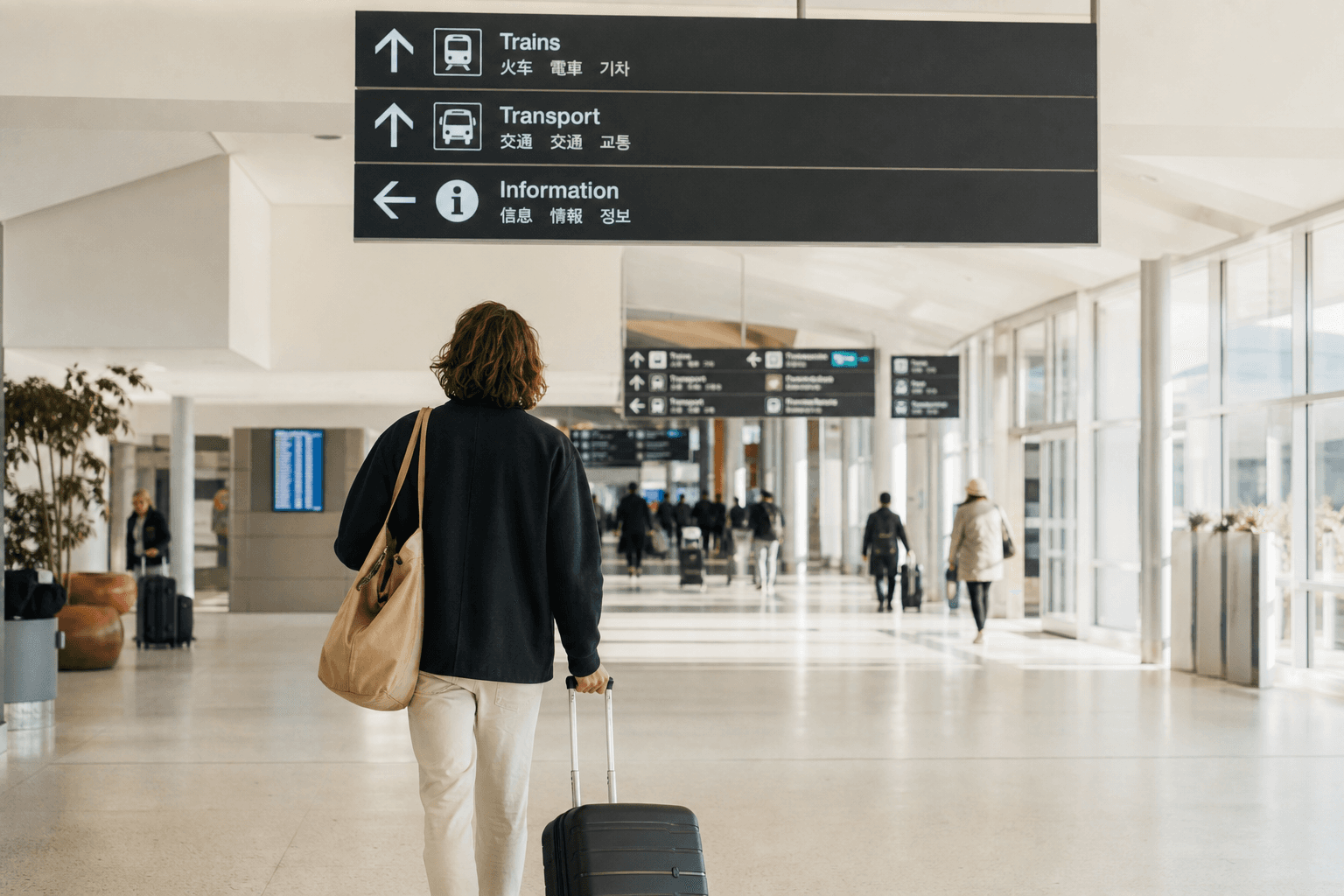
The aircraft door opens. Corridor air replaces cabin air. Signs appear in Japanese and English pointing toward immigration, transfers, and baggage claim — and for a moment the day compresses into one question: what comes next, in order?
That sequence is more stable than any single airport map. Whether you land at Narita, Haneda, Kansai, Chubu Centrair, Fukuoka, or another major international gateway, the first hours follow the same practical rhythm: clear immigration, collect bags, pass customs, then arrange connectivity and money if you still need them, then choose how to reach the city.
This article is not a terminal guide, an airline briefing, or a ranking of airports. It is the arrival workflow — the decisions that turn landing into a calm first day rather than a pile of small frictions at the wrong moment.
When you know the sequence, the specific airport matters less. You read the signs in front of you, take the next step, and let the city arrive when transport delivers you to the station or hotel you already chose.
The Short Answer
After landing at a major international airport in Japan, move through immigration, baggage claim, and customs in that order — then handle connectivity and cash in the arrival lobby if you still need them, then choose transport into the city.
All foreign nationals submit an Immigration Record, called an ED card — electronically through Visit Japan Web or on paper, per Immigration Services Agency guidance. Visit Japan Web is recommended by ISA and JNTO but not mandatory. An immigration officer still examines each traveler even when you use Visit Japan Web. Register each person separately; a unified two-dimensional code covering both immigration and customs has been available since January 25, 2024, per Japan Customs.
Carry a valid passport. Visa requirements depend on nationality — check JNTO before departure. COVID-19 vaccination or test certificates have not been required for entry since April 29, 2023, per JNTO.
All passengers must complete customs declaration. Green and red channels apply. e-Gates exist at seven airports — New Chitose, Narita, Haneda, Chubu Centrair, Kansai, Fukuoka, and Naha — and require an IC-enabled passport; baggage may still be inspected. Declare cash of ¥1 million or more. Meat and plants are prohibited without proper permits, per JNTO.
Major airports connect to cities by train, airport bus, and taxi. Research timetables before travel rather than deciding at the curb. Connectivity and cash have dedicated guides — see eSIM vs Pocket Wi-Fi in Japan and Cash or Card in Japan for setup depth; this article only places them in the sequence.
Your First Decisions After Landing
Treat the first hour as a chain of decisions, not a tour of the building.
Land and follow airside signs toward immigration — not toward shops or lounges unless you deliberately need a few minutes seated before the queue.
Immigration comes before baggage at every major international airport. Have passport, ED card or Visit Japan Web QR code, and visa documents if your nationality requires them ready in your day bag — see What to Pack for Japan for what should stay on your person through this checkpoint.
Collect baggage once cleared. Check the carousel display against your flight; if bags are delayed, note the airline desk location before you leave the hall.
Customs follows baggage. Choose the channel that matches your declaration — green if you have nothing to declare beyond personal effects, red if you are carrying restricted goods, large cash amounts, or items you are unsure about.
Arrange connectivity and money in the arrival lobby if you still need them — terminal Wi-Fi can finish an eSIM activation; airport ATMs and exchange counters exist at major gateways. Do not let either task block the transport decision indefinitely.
Choose transport into the city last among these steps — train, airport bus, or taxi depending on hour, luggage, and destination station. Taking the Bus in Japan covers local city buses only; airport limousine and express buses are a separate product with different ticketing.
Haneda's official passenger sequence, when quarantine applies, runs: quarantine if needed, immigration, baggage, animal and plant quarantine if applicable, customs, then arrival lobby. Other airports follow the same broad logic with local signage.
The practical sequence most international arrivals follow before reaching the city.
Land
Follow airside signage toward immigration and transfers — not toward optional stops until the formal sequence is complete.
Immigration
Present passport and ED card or Visit Japan Web QR; an officer examines each traveler even with electronic registration.
Collect baggage
Claim checked luggage at the carousel for your flight before proceeding to customs.
Customs
Declare as required; choose green or red channel; e-Gates at seven major airports require an IC passport.
Arrange connectivity and money if needed
Use terminal Wi-Fi for eSIM activation, airport ATMs, or exchange if you still need data or yen before leaving.
Choose transport into the city
Train, airport bus, or taxi — match hour, luggage, and destination station; confirm timetables you researched before travel.
Sequence before shopping. Joint immigration-customs kiosks exist at some terminals only — follow local signs rather than assuming one system nationwide.
Immigration and Customs
Immigration and customs are separate checkpoints with linked paperwork — not one interchangeable desk.
Entry: All foreign nationals submit an Immigration Record. Visit Japan Web lets you register before arrival and produce a QR code per person. Paper ED cards remain available. ISA and JNTO recommend Visit Japan Web; neither makes it mandatory. Officer examination still applies with electronic registration.
Since January 25, 2024, Japan Customs notes a unified two-dimensional code can cover both immigration and customs procedures when issued through the integrated system — individual registration per traveler still applies.
Passport validity and visa rules depend on nationality. JNTO publishes visa guidance by country. No COVID-19 vaccination or test certificate has been required for entry since April 29, 2023.
Customs: All passengers must declare. Green channel suits travelers with only personal effects within normal limits. Red channel — or staff direction — applies when carrying goods that require declaration, including cash over ¥1 million, meat, plants, or items you cannot confidently classify as exempt.
e-Gates operate at New Chitose, Narita, Haneda, Chubu Centrair, Kansai, Fukuoka, and Naha for eligible IC-passport holders. They speed document reading; they do not eliminate the possibility of baggage inspection.
Joint automated kiosks combining immigration and customs steps exist at some terminals — including Kansai Terminals 1 and 2, Haneda Terminals 2 and 3, Narita Terminal 3, and Fukuoka — with hours that vary by location, per ISA. They are not universal. If your terminal uses separate queues, follow the posted sequence.
Quarantine for animal and plant products may appear between baggage and customs when applicable. When in doubt about food or agricultural items, declare rather than assume exemption.
Money and Connectivity
The arrival lobby is the practical place to solve two small gaps — not the place to rebuild your entire payment or phone setup from scratch.
Connectivity: If you chose an eSIM or pocket Wi-Fi before departure, the arrival hour is when you confirm data works. Major airports provide terminal Wi-Fi — Haneda documents HANEDA-FREE-WIFI among its networks — useful when activation still needs a few minutes online. Full comparison of eSIM, pocket Wi-Fi, and alternatives lives in eSIM vs Pocket Wi-Fi in Japan; test maps and your hotel address here before boarding a long train ride.
Cash and cards: JNTO advises carrying some cash even when cards cover most city spending. Major airports offer currency exchange, and ATMs at Narita, Haneda, Chubu Centrair, Kansai, Fukuoka, and Naha accept many foreign cards through accessible networks — see Cash or Card in Japan for ATM strategy and how much to carry, not repeated here.
IC cards: Many travelers buy or load a Suica, PASMO, or regional equivalent at the airport station counter or machine once you reach the rail area — timing and product choice are covered in IC Cards in Japan. An IC card is not required before you leave the terminal, but having one before the first city gate reduces friction.
Keep passport, phone, wallet, and activation details in your day bag through this stretch — not in checked luggage you may have just collected.
Choosing Your Transport
Airport transport is a category decision — train, airport bus, or taxi — not a contest with one universal winner.
Train suits travelers heading toward a known station on a published airport rail line, with moderate luggage, during hours when service runs frequently. Haneda sits closer to central Tokyo — roughly thirty minutes by train per JNTO airport-access guidance. Narita is farther — about sixty kilometers from central Tokyo — but well connected by rail. Fukuoka Airport links to Hakata Station in about five minutes by train, per JNTO. Research departure times before travel; last trains and reduced holiday service matter on night arrivals.
Airport bus suits travelers whose hotel or district sits on a published limousine route, those with heavier bags who prefer curbside boarding, or arrivals when rail connections would require multiple transfers with luggage. Buses are not the same product as local city buses — Taking the Bus in Japan covers municipal services only.
Taxi suits late-night arrivals when rail and bus options thin out, small groups sharing fare, or destinations poorly served by rail from your specific airport — at higher cost and with variable traffic time.
Your accommodation choice should align with the airport you use — Where to Stay in Tokyo assumes you know whether Haneda or Narita anchors night one. If you hold a Japan Rail Pass, remember that eligibility depends on Temporary Visitor status stamped or documented at immigration — a light touch at entry, not a separate airport procedure.
Confirm the last service time for your chosen mode before you leave the arrival hall. Standing at a ticket machine after midnight with a closed line is a common first-day friction worth five minutes of pre-travel reading.
Three transport categories from major airports — each fits different hours, luggage, and destinations.
Train
Your destination sits on a published airport rail line, luggage is manageable, and service runs at your arrival hour.
Often fastest to major hubs — Haneda closer to Tokyo, Narita farther but connected, Fukuoka minutes to Hakata. Confirm timetables before travel.
Airport bus
Your hotel or area lies on a limousine route, bags are heavy, or rail would mean awkward transfers with luggage.
Different from local city buses. Route and frequency vary by airport — not interchangeable with municipal bus guidance.
Taxi
You arrive very late, travel in a small group, or your address is poorly served by rail and bus from this airport.
Highest cost; traffic affects time. Useful when public service has ended for the night.
No universal winner. Match airport, hour, luggage, and the station or district you already chose.
Getting to Your Accommodation
Transport delivers you to a station or curb — not automatically to a hotel door. The last segment still requires attention.
If check-in is hours away, decide before you leave the airport whether you will store luggage at the station — Using Coin Lockers in Japan — or send it ahead — Luggage Forwarding in Japan — rather than dragging suitcases through lunch crowds.
Hotels often hold bags before official check-in when policy allows; confirm by message if your arrival is very early. Vacation rentals and smaller guesthouses may have tighter windows — know the handover plan before you board the train.
Foreign visitors without a Japan address must present a passport at hotel check-in, per JNTO FAQ guidance cited elsewhere in this library. Keep it in your day bag, not in forwarded luggage.
Navigate from the arrival station to the hotel using the exit your booking references — a five-minute walk from the wrong exit can double after dark, especially on night one. Connectivity tested in the airport lobby should carry you through this leg; if not, station information desks can orient you without requiring perfect Japanese.
If your first night sits in Tokyo, neighborhood choice should already reflect which airport and station you used — Where to Stay in Tokyo picks up that decision; this section ends when you reach the lobby or rental door.
What If You Arrive Late?
Late arrival changes frequency, not the sequence. Immigration, baggage, and customs still run — often with shorter queues — but rail and bus options may thin after midnight.
Check last train and last airport bus times for your specific airport and destination before you fly. Haneda and Narita both publish late-service options, but lines do not run twenty-four hours on every route. A taxi becomes more reasonable when public service has ended and you are traveling with tired companions.
Terminal exchange counters and ATMs at major airports generally serve late arrivals, though individual machine hours vary. If you depend on cash for the first taxi or bus, withdraw in the arrival hall rather than assuming a neighborhood ATM will be open at 1 a.m.
Hotels near major stations sometimes suit late arrival better than residential side streets you have never walked — another reason to choose base before hunting room photos. If check-in is closed, confirm whether the property offers late entry or bag drop so you are not standing on a quiet lane searching for an intercom.
Late arrival is a transport-and-hotel planning problem more than an immigration surprise. The workflow in this article still applies — only the train-versus-taxi choice tilts toward whichever option is actually running when you clear customs.
Luggage on Arrival
Luggage decisions on day one echo through the whole trip — especially when checkout and check-in do not align.
Carry-on should hold what you cannot afford to lose or wait for: passport, medications, phone, chargers, wallet, and one weather layer. What to Pack for Japan describes day-bag logic in full; arrival is where that logic matters most.
Checked bags belong on the carousel before customs — not repacked in the immigration queue. If an airline forwards delayed luggage, note the delivery desk location and keep essentials on your person overnight.
Oversized or multiple suitcases push toward airport bus or taxi rather than crowded commuter trains at rush hour. Forwarding from the airport or first hotel is possible on some routes — see Luggage Forwarding in Japan — but same-day city exploration is easier when you store or send heavy bags before sightseeing.
Coin lockers at city stations help on afternoon-only gaps; they rarely solve a late-night airport arrival before hotels open. Plan storage mode when you choose transport, not after you have already climbed the wrong stairwell with both wheels.
Hands-free arrival is a sequence choice: what you carry off the plane, what you store at the first hub, and what you forward before the second city.
Common First-Time Questions
Do I have to use Visit Japan Web?
No. ISA and JNTO recommend it; paper ED cards remain available. Officer examination applies either way.
Can one QR code cover my whole family?
No. Register each traveler individually for Visit Japan Web, per ISA.
Which customs channel should I use?
Green if you have nothing beyond personal effects within normal limits. Red — or staff — if you carry declarable goods, ¥1 million or more in cash, meat, plants, or anything uncertain.
Can I use the e-Gate?
Only at the seven airports that offer them and only with an IC-enabled passport. Baggage may still be inspected.
Should I buy an IC card at the airport?
Many travelers do, but you can also buy at your first city station. See IC Cards in Japan for product choice — not every card suits every route.
Is the airport train always the best option?
No. Buses and taxis fit some hours, routes, and luggage loads better. Research your specific airport and destination.
Does this article cover local buses in Kyoto or Tokyo?
No. Taking the Bus in Japan covers municipal buses. Airport buses are separate products.
What if my hotel is not ready?
Ask about bag hold, use station lockers if size allows, or sightsee lightly without unpacking — Planning Less, Seeing More applies to how much you schedule before sleep.
Practical Tips
Complete Visit Japan Web or prepare paper ED cards before landing when possible — the queue moves faster when documents are ready.
Keep passport, QR codes, and visa papers in your day bag, not in checked luggage.
Screenshot hotel address and arrival station in Japanese and English before wheels down.
Test connectivity and one map lookup in the arrival lobby before boarding a long train.
Withdraw modest yen or confirm IC card purchase plan before you leave the terminal if rural or cash-heavy days follow.
Research last train and bus times if your flight lands after 9 p.m.
Match luggage strategy to transport — train at rush hour with two large suitcases is a self-inflicted first day.
Read Best Time to Visit Japan for seasonal crowding that affects immigration lines and holiday rail service — not for repeating airport detail here.
If Shinkansen travel starts within forty-eight hours, skim How to Use the Shinkansen in Japan for station rhythm — separate from airport rail but often the next leg after Tokyo arrival.
Why the First Hour Shapes the Whole Trip
The first hour sets expectations more than any single sightseeing block.
When immigration paperwork is ready, cash or IC card is sorted, data works, and transport matches the hour, the rest of the day inherits calm. When those pieces are deferred until a platform in a hurry, every later step pays interest — missed exits, unpaid lockers, messages sent over roaming, taxis taken from exhaustion rather than choice.
Japan's major airports are built for volume. The procedures are standardized enough that a traveler landing at Fukuoka and a traveler landing at Narita face the same decision order even when the signage differs. Learning the sequence once transfers to the second arrival on the same trip.
The goal is not to optimize the airport as a destination. It is to pass through efficiently enough that the city — the meal, the neighborhood walk, the check-in shower — becomes the first memory rather than the ticket machine that closed before you reached it.
Arrival infrastructure is travel infrastructure, like IC cards, cash, and connectivity elsewhere in this library. Handle it once, calmly, then leave it behind.
Before You Go
Register Visit Japan Web or confirm paper ED card availability for your airline and airport.
Verify passport validity and visa rules for your nationality on JNTO and MOFA guidance.
Choose connectivity and test compatibility before departure — eSIM vs Pocket Wi-Fi in Japan.
Decide cash, card, and IC card approach — Cash or Card in Japan and IC Cards in Japan.
Research airport-to-city timetables for your landing hour and destination station.
Confirm hotel check-in time, late arrival policy, and nearest station exit.
Pack day-bag essentials per What to Pack for Japan.
Save emergency numbers and koban orientation per Safety in Japan — thirty seconds after connectivity works in the arrival lobby.
If Tokyo is night one, read Where to Stay in Tokyo with your arrival airport in mind.
Note seasonal travel pressure from Best Time to Visit Japan when immigration and rail crowding may add minutes — not hours — to the sequence.
The door opens. The signs point forward. Immigration, baggage, customs, then the small practical tasks — connection, cash, transport — and then the city.
That order does not change because an airport has a better shopping floor or a faster train brand. It changes only when your flight, your luggage, or your hour pushes one transport mode ahead of another.
Prepare documents and timetables before you land. Keep essentials on your person. Test data once in the arrival lobby. Choose the train, bus, or taxi that matches the station you already planned to reach.
When the sequence is familiar, the airport disappears into the background — and the first day begins where you wanted it to: not at the carousel, but on the street or in the lobby that comes after.
Related Reading
Continue exploring this way of seeing Japan.
- eSIM vs Pocket Wi-Fi in Japan: Which Should You Choose?
- Cash or Card in Japan?
- IC Cards in Japan
- Where to Stay in Tokyo: Choosing the Neighborhood That Fits Your Trip
- What to Pack for Japan: Choosing What Is Worth Carrying
- How to Use Luggage Forwarding in Japan
- Using Coin Lockers in Japan: When They Make a Travel Day Easier
- Planning Less, Seeing More