Tokyo
Where tradition and restless energy move side by side.
When does sending luggage ahead make a travel day simpler — and when is carrying it yourself the clearer choice?
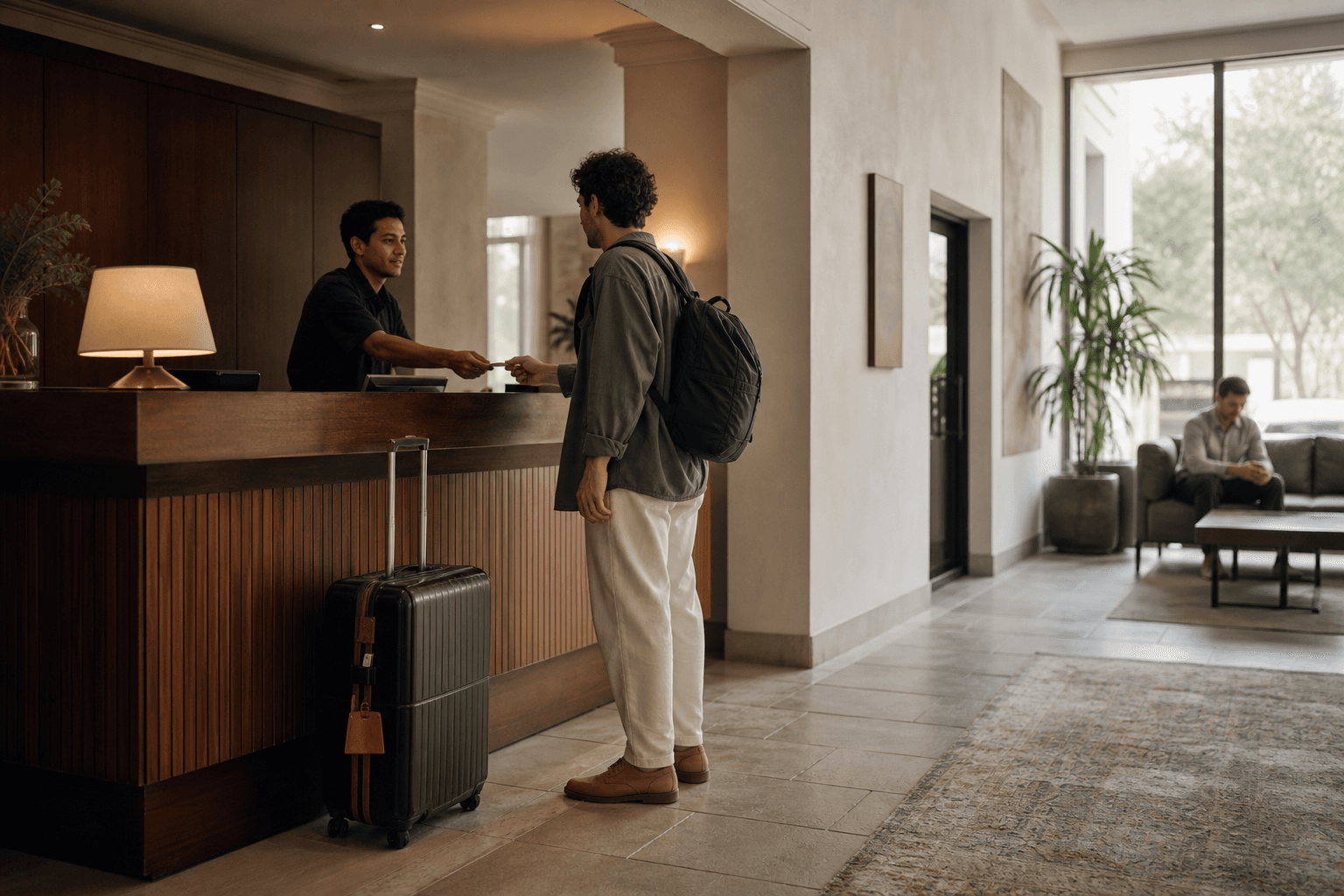
On a travel morning in Tokyo, a guest checks out with only a small shoulder bag. The main suitcase is already on its way to Kyoto. At the station, there is no search for an elevator wide enough for wheels, no negotiation over locker size, no second thought about changing platforms with both hands full. The Shinkansen boarding feels ordinary — which is precisely the point.
Luggage forwarding in Japan does not solve every trip. It is not a ritual travelers must complete to travel correctly. It is a logistics option that changes one day: the day you would rather walk through a station like a passenger, not like a porter.
The service becomes useful when it removes friction from a specific transfer — not because suitcases are inherently a problem. The practical question is whether your next travel day is simpler with the bag beside you or waiting at your next stop.
Japan has established door-to-door parcel delivery services, commonly called takuhaibin (宅配便). Yamato Transport's TA-Q-BIN — often referred to in English as Takkyubin — is the most widely used carrier for traveler luggage, but other providers offer similar services with their own rules.
Many hotels, airports, Yamato sales offices, and some convenience stores can accept luggage for forwarding. Availability, cutoff times, and procedures vary by location and provider. Delivery is not universally same-day. For hotel-to-hotel shipments, Yamato advises sending so luggage arrives at least one day before your check-in date.
Keep medicines, travel documents, valuables, electronics, chargers, and at least one night of clothing and toiletries with you. Forwarding is especially useful between staffed hotel stays, before complex rail transfers, or when visiting destinations with limited luggage storage. It may be unnecessary for short direct journeys or when the next accommodation cannot confirm receipt.
Forwarding helps when a particular travel day would otherwise be spent managing weight, not making the journey.
It is often useful when:
You are changing cities by train — for example Tokyo to Kyoto, Osaka, or Hiroshima. Your route includes several transfers, crowded stations, or stairs. You have one night between two longer hotel stays and want to travel light. You are traveling with children or carrying large suitcases. You are visiting an onsen town, ryokan, island, or rural stop where station lockers or taxis are limited. You want luggage waiting at an airport counter before departure day.
It may be simpler to carry luggage when:
The journey is direct and short. Your suitcase is small enough to manage comfortably. You need same-day access to everything in the bag. You need only a same-city pause of a few hours — a check-in gap or afternoon before an evening train — and will return to the same station; see Using Coin Lockers in Japan instead of forwarding. The receiving property cannot confirm advance receipt. The delivery window does not fit your itinerary. Your route or destination has limited service — some remote islands and specialty routes need extra lead time. You are changing accommodation unexpectedly. You are renting a car for part of the trip — the vehicle itself carries your luggage between stops, which removes most of the reason to forward it.
A mixed approach is common: forward the large suitcase, carry a compact overnight bag with essentials. That is often the best fit for a ryokan night between city hotels.
Match how you move luggage to the job each travel day is doing.
Forward the luggage
A multi-transfer travel day would be easier without a full suitcase.
Works well between staffed hotels when delivery timing is confirmed in advance.
Carry it yourself
The journey is short, direct, or you need everything in the bag that same day.
Often cleaner for one-city stays or when the next property cannot accept advance delivery.
Forward only the large bag
You want a light travel day but still need essentials until the suitcase arrives.
Common between city hotels and a ryokan night, or before a long Shinkansen leg.
None of these is automatically better. The fit depends on your route, timing, and accommodation.
Takuhaibin is the general Japanese term for door-to-door parcel delivery. Residents use it constantly — not only for travel — to send packages between homes, offices, stores, and pickup counters.
For travelers, the practical version is simple: a courier collects a closed suitcase or bag at one staffed location and delivers it to another address you specify, usually a hotel front desk, airport baggage counter, or Yamato sales office.
TA-Q-BIN is Yamato Transport's core parcel service. The company also markets traveler-oriented products such as Airport TA-Q-BIN and Round Trip TA-Q-BIN for accommodation. TA-Q-BIN is a service name and trademark — not a generic word for every carrier in Japan. Sagawa Express and Japan Post operate separate delivery networks with their own acceptance points, forms, and rules. When a hotel says it can forward luggage, it usually means staff can arrange shipment through a partner courier, most often Yamato.
The service does not replace airline check-in. Airport delivery moves your bag to an airport collection counter before your flight. You still complete airline baggage procedures separately.
Although details vary by provider and drop-off point, the sequence is consistent:
1. Confirm the receiving hotel, airport counter, or sales office can accept your luggage on the date you need it. 2. Confirm the intended arrival date — for hotel delivery, Yamato advises arrival at least one day before check-in. 3. Pack and close the luggage securely. Yamato requires suitcase zippers fully fastened before acceptance. 4. Complete a shipping waybill with sender details, destination address, parcel size, requested delivery date, and recipient name. 5. Pay the delivery charge and keep the receipt with the tracking number. 6. Travel with medicines, documents, valuables, electronics, and overnight essentials in a separate bag. 7. Collect the luggage at the destination, or confirm it is waiting in your room or at the hotel front desk.
Hotel staff often handle much of this process when the property participates. At a convenience store or sales office, you complete the form yourself or ask staff for assistance. Cutoff times matter: missing the day's shipping deadline pushes delivery back at least one day.
Confirm both ends first, then ship, then travel light until collection.
Confirm the destination
Verify the hotel, airport counter, or sales office can receive luggage on your date.
Choose the arrival date
Allow at least one day before check-in for hotel delivery when possible.
Complete the form
Enter sender, destination, size, delivery date, and booking name on the waybill.
Pay and keep the receipt
Retain the receipt and tracking number until the bag is collected.
Travel with essentials
Carry documents, medicine, valuables, and one night of necessities separately.
Collect the luggage
Pick up at the front desk, airport counter, or sales office as arranged.
Common send points include:
Hotels and ryokan with staffed front desks that partner with a courier. Yamato Transport sales offices and TA-Q-BIN agencies. Some convenience stores — 7-Eleven and FamilyMart commonly accept Yamato drop-offs, with size limits. Some airport and major station counters. Your accommodation may refuse if it lacks a staffed desk or courier partnership.
According to Yamato's FAQ, hotel-to-hotel forwarding is possible when the sending hotel partners with Yamato and the receiving property can accept luggage at the front desk. Always confirm both ends.
Vacation rentals, hostels without daytime reception, and unattended apartments are harder. Yamato advises that if shipping from an Airbnb is not possible at the property, bring luggage to a convenience store or sales office instead. That extra step is workable, but it changes whether forwarding is worth the effort on that day.
Typical destinations:
Another hotel or ryokan front desk in a different city. An airport baggage counter for departure-day collection. A Yamato sales office for temporary custody and later pickup.
Hotel delivery generally requires a staffed front desk that agrees to hold luggage until you arrive. Guesthouses may accept parcels if staff are present; confirm by email or phone rather than assuming.
Vacation rentals without reception rarely work unless you arrange an alternative staffed counter nearby. Unattended key-box apartments are poor destinations for courier delivery.
Airport TA-Q-BIN delivers to airport collection counters, not directly to airline check-in belts. You must have a flight departing from that airport on the day you collect the bag, per Yamato's Airport TA-Q-BIN guidance.
Timing depends on origin, destination, drop-off time, service type, weather, holidays, remote routing, and seasonal demand. Next-day delivery is common on many mainland routes, but it is not a promise you should plan around without checking.
Yamato's rate tool notes that stated delivery times do not include the day of shipping. Deliveries may take longer for remote islands, severe weather, or peak periods.
Practical rules from official Yamato guidance:
Hotel-to-hotel: send so luggage arrives at least one day before check-in. If you check in on February 1, it should reach the hotel by January 31. Airport TA-Q-BIN: send at least two to three days before departure depending on region; the bag should reach the airport counter at least one day before your flight. For Narita departures, Yamato gives route-specific examples — shipping from Tokyo typically requires earlier drop-off than shipping from nearby prefectures. Same-day delivery exists in limited areas such as Osaka and Kyoto through specific Yamato counters, but it is a separate product with its own counters and pricing — not the default hotel-forwarding service.
When in doubt, add a buffer day, especially for Hokkaido, Okinawa, long cross-country routes, or travel around national holidays — see Living by the Calendar.
Prices are generally determined by size category, weight, distance or destination zone, and any specialty service such as Airport TA-Q-BIN.
Yamato measures parcel size as the total of length, width, and height in centimeters. The charged size is whichever is greater — dimensional total or weight band. A suitcase measuring 70 cm total but weighing 9 kg is billed as Size 100, not Size 80.
Standard TA-Q-BIN accepts parcels up to 200 cm total dimensions and 30 kg. Each parcel includes liability coverage up to ¥300,000 (tax included) under Yamato's standard service terms.
Use the carrier's official rate tool rather than memorizing national price bands. Rates change, discounts apply at some counters, and Airport TA-Q-BIN adds airport handling fees on many routes.
Verified example (Yamato Kyoto promotional rate table, July 2026): Size 160 luggage on next-day service from Kyoto city to Tokyo or Fukuoka costs ¥3,160 per bag. Same table shows Size 100 Kyoto to Tokyo at ¥1,860. These are illustrative one-way mainland examples — your route, size, payment method, and service type may differ.
Airport TA-Q-BIN rates include airport handling fees on many outbound routes. Yamato lists an additional ¥660 airport fee when sending to the airport on standard Airport TA-Q-BIN, with exceptions noted on the official rate page.
Convenience-store drop-offs qualify for Yamato's posted discount programs, but only accept suitcases up to Size 160 at any convenience store, with some locations restricting parcels above Size 180.
Hotel-to-hotel forwarding is the use case most international travelers encounter. It works best when both properties are staffed hotels that routinely receive courier parcels.
Before sending:
Ask the sending hotel whether it offers luggage forwarding and what time bags must be ready. Confirm the receiving hotel will accept luggage before your check-in date. Use the same reservation name on the waybill as on your booking. Include check-in date and booking reference if the hotel requests them. Ask whether staff complete the waybill for you or expect you to fill it in. Confirm payment method — hotel charges may be added to your room bill at some properties.
This is not universal. Budget hostels, guesthouses with limited reception hours, and vacation rentals may not accept advance luggage. For a ryokan night, forwarding a large bag ahead while you carry a small bag can protect tatami from wheeled suitcases — a practical pairing discussed in Ryokan vs Hotel in Japan.
If the receiving hotel cannot confirm receipt, do not send the bag. Unattended delivery is not a service travelers should rely on.
Airport forwarding runs in two directions, each with stricter timing than ordinary hotel delivery.
Hotel or counter to airport: Use Airport TA-Q-BIN. Yamato advises sending two to three days before departure depending on region, with the bag reaching the airport collection counter at least one day before your flight. Limited express Time Service is not available for airport-bound luggage. You must have a flight departing from that airport on the day you collect the bag. Departure date can be specified up to ten days after the shipping date.
Airport to hotel: Yamato's Airport TA-Q-BIN above is oriented toward the hotel-to-airport direction. For delivery from the airport to your hotel on arrival, JAL ABC operates a separate baggage delivery service at Narita, Haneda, and Kansai airports, with more limited arrangements at Chubu — a distinct provider from Yamato, with its own counters, forms, and cutoffs. Same-day delivery to a hotel is sometimes available depending on the airport, counter, and arrival time, but participating counters and cutoff times vary and change, so confirm current conditions directly with JAL ABC rather than assuming a fixed schedule. Neither Airport TA-Q-BIN nor JAL ABC is guaranteed at every terminal or arrival time, and one provider's rules do not carry over to the other. For what else to plan in your first hours after landing, see Airport Arrival Guide: Your First Hours in Japan.
Airline check-in and courier delivery are separate systems. A bag at an airport courier counter is not checked airline baggage until you complete airline procedures. Build margin before international connections.
For departure from Narita, Yamato publishes route-specific shipping examples showing how earlier origins require earlier ship dates. Use those tools rather than assuming a universal two-day rule.
Separate three categories:
Items you should keep with you for practical reasons: passport and visas, tickets, wallets, payment cards, prescription medicine, glasses, essential electronics, chargers, one change of clothing, toiletries, and anything needed before the delivery date.
Items unsuitable for courier handling: fragile valuables you cannot replace, loose liquids that may leak, and unpacked items that shift inside a soft bag.
Items prohibited or restricted by the carrier: Yamato publishes a prohibited-items list for TA-Q-BIN, including dangerous goods and certain restricted articles. Spray cans face air-freight restrictions on routes Yamato ships by air — including Okinawa and some long-distance island or regional pairings listed in Yamato's air-freight guidance.
Suitcases within 200 cm total dimensions and 30 kg are generally acceptable on TA-Q-BIN. Convenience stores cap suitcase drop-offs at Size 160. Zippers must be fully closed; Yamato may refuse otherwise. A special cover is not required, though Yamato notes scratches or stains may occur because the suitcase itself acts as packaging.
Do not treat one carrier's prohibited-items list as universal. Check the provider you actually use.
The waybill is the operational core of forwarding. Yamato waybills are primarily in Japanese. Hotel staff at participating properties often complete them for guests. At sales offices, staff may assist. At convenience stores, you may need more self-sufficiency.
Typical fields:
Sender name, phone number, and address. Recipient name, phone number, and destination address. Parcel size category. Requested delivery date. Contents description — Yamato requires a detailed description; vague entries can delay or prevent delivery. Payment method.
Practical advice:
Use the destination address in Japanese when possible. Booking confirmations often include the Japanese hotel address; show it to staff rather than relying on romanized text alone. Match the recipient name to your hotel reservation. Double-check the delivery date against your check-in date. Photograph the completed form and receipt.
Multilingual assistance varies by counter. Hotels remain the easiest entry point for many international travelers precisely because staff routinely handle these forms.
Treat the overnight bag as insurance against delay, not as a backup wardrobe.
Keep with you:
Passport, visas, and other travel documents. Cash, cards, and payment tools. Prescription medicines and any medical items needed within 24–48 hours. Phone, charger, and essential electronics. Glasses, contacts, and personal medical devices. One change of clothing appropriate for the season. Toiletries and personal care items for one night. Weather layer — umbrella, light jacket, or hat as conditions require. Anything required for meetings, reservations, or transit before the suitcase arrives.
If you are heading to a ryokan, also carry what that night requires before your main bag arrives: modest sleepwear if you prefer it under yukata, any critical toiletries, and items you do not want handled as courier freight.
The goal is not to duplicate the entire suitcase. It is to remain functional if delivery slips by a day.
For a fuller packing-strategy view of what belongs in a day pack versus a forwarded suitcase, see What to Pack for Japan.
Forwarding and rail tickets solve different problems. A courier does not reserve a Shinkansen seat, activate a Japan Rail Pass, or replace an IC card for local gates.
Where forwarding helps rail travel:
You can board intercity trains without lifting a large suitcase through ticket gates, concourses, and narrow train vestibules. You can change stations more comfortably on days with multiple transfers. You can pair a hotel night in Osaka with a ryokan night elsewhere without dragging full luggage onto local lines.
What forwarding does not do:
It does not exempt you from oversized baggage rules on trains that require reservations for very large luggage — see How to Use the Shinkansen in Japan for how that reservation works. It does not speed up trains or simplify seat selection. It does not pay fares or replace platform planning.
For many multi-city itineraries, the sensible combination is a rail pass or individual tickets for long legs, an IC card for urban movement, and forwarding only on the heaviest transfer days. That is logistics stacking, not a single product solving everything.
Assuming delivery is always next-day.
Sending all essentials in the forwarded bag.
Failing to confirm the receiving hotel or ryokan will accept advance luggage.
Using a vacation-rental address with no staffed reception.
Writing the wrong arrival or check-in date on the waybill.
Dropping luggage after that location's shipping cutoff.
Losing the receipt and tracking number.
Assuming every convenience store accepts every provider or every suitcase size.
Sending airport-bound luggage too late for the route.
Treating TA-Q-BIN rules as universal across Sagawa, Japan Post, or hotel-specific couriers.
Planning same-day wardrobe needs from a bag that will not arrive until tomorrow.
Forwarding every leg of a trip when one heavy transfer day is the actual problem.
Confirm both sending and receiving properties before you pack for checkout.
Photograph the completed waybill and paid receipt.
Use one consistent booking name across reservation and waybill.
Pack a dedicated overnight bag before you close the forwarded suitcase.
Add a buffer day for remote routes, islands, peak seasons, or holiday travel.
Ask hotel staff for help early — the night before departure, not five minutes before checkout.
Place identifying contact information inside the suitcase as well as on the waybill.
Track the shipment on the carrier's site when a tracking number is provided.
For Tokyo to Kyoto moves, check rates and delivery times on Yamato's official tool rather than relying on old forum examples.
If a ryokan night sits between city hotels, forward the large bag and carry essentials — see Ryokan vs Hotel in Japan for why tatami rooms reward lighter arrivals.
Some convenience stores act as Yamato parcel send counters — see Convenience Stores in Japan for when that fits a travel day and what it does not replace.
Japan's luggage-forwarding network is not a tourist invention. It is part of the same parcel infrastructure residents use to send goods between homes, stores, and offices. Hotels, airports, convenience stores, and courier counters connect into an everyday distribution system.
That is why the service can feel seamless in some hotels and invisible in others: participation depends on staffing, partnerships, and whether a property routinely receives parcels for guests.
The usefulness for international travelers comes from timing — sending a suitcase ahead on the one day you would rather move through Tokyo, Osaka, or Kyoto stations lightly. It does not require admiration for logistics. It requires reading your itinerary honestly and choosing the lighter day when the lighter day exists.
Identify which travel days are painful because of luggage, not because of distance.
Confirm both hotels can send and receive courier luggage on your dates.
Check size, weight, and prohibited-item rules for your chosen carrier.
For airport departures, look up Airport TA-Q-BIN cut-off dates for your origin and airport — do not guess.
Pack essentials and one night of clothing into a separate bag before sealing the forwarded suitcase.
Save the Japanese address of your next hotel.
Align forwarding with rail plans: tickets, pass validity, and IC-card city movement are separate tasks.
If weather or holiday peaks may affect delivery, ship one day earlier than the minimum.
Treat forwarding as a tool for a specific day, not a default for every intercity move.
Luggage forwarding in Japan is worth using when it changes a travel day you can already name: the morning you would rather board a train with one small bag, the transfer across Tokyo and Kyoto that should not hinge on elevator width, the ryokan night where tatami is easier without wheels in the room.
It is not worth forcing into an itinerary that moves simply already. Carrying a small suitcase through a direct route can be faster than confirming two hotels, completing a waybill, and waiting for delivery.
The better journey is not the one that forwards the most luggage. It is the one where each heavy day is handled deliberately — and the rest of your attention stays on where you are going, not on what you are dragging to get there.
Continue exploring this way of seeing Japan.