Kyoto
Where tradition still shapes everyday life.
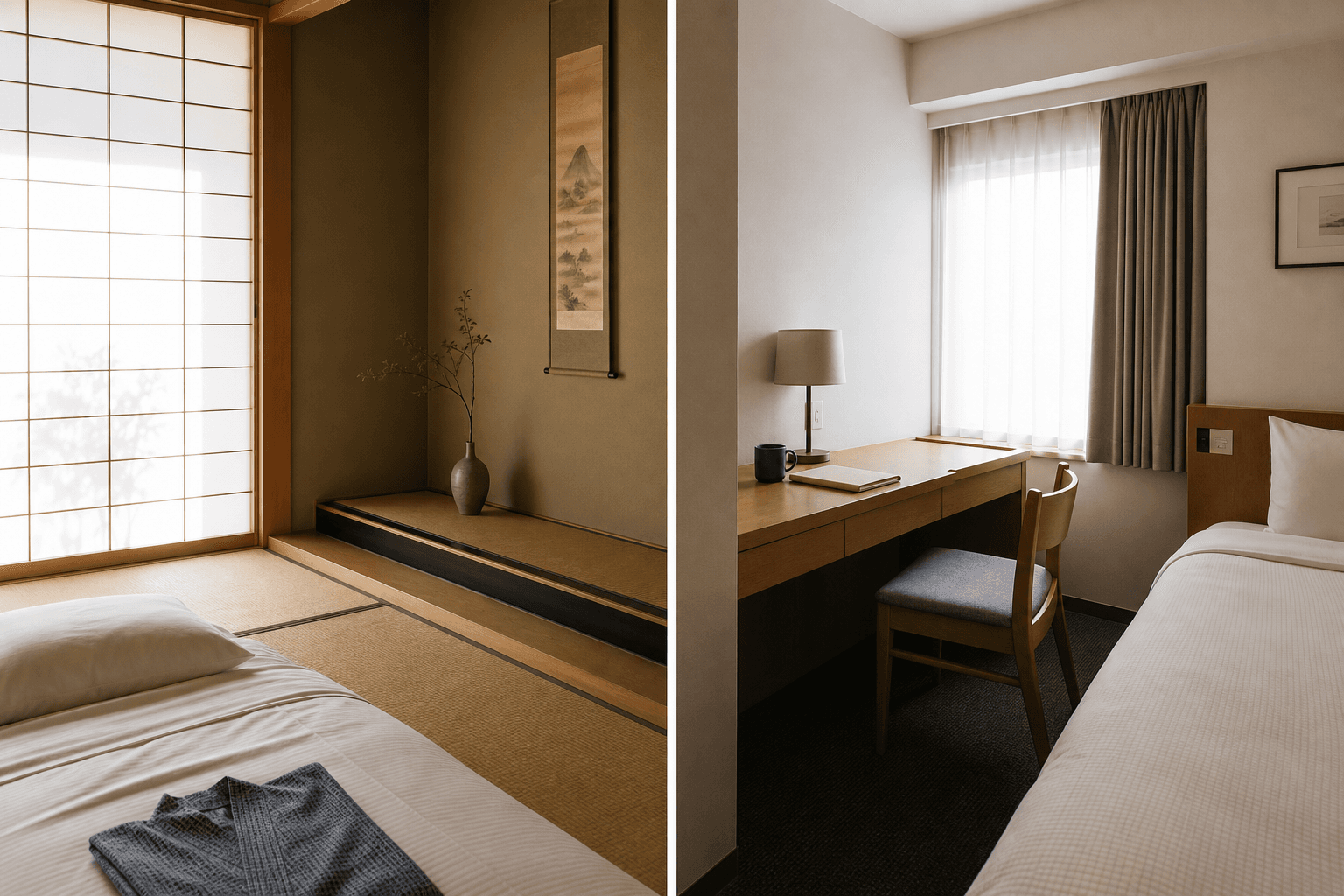
Should your stay follow the pace of a ryokan evening or the flexibility of a hotel?
Many travelers compare hotels and ryokan by price, room size, or distance from the station. Those details matter when you are building an itinerary.
After returning home, what people often remember is not the square meters of the room. It is the pace of the evening: whether dinner had a fixed time and a sequence of courses, whether the bath was shared or private, whether the day ended quietly in a yukata or flexibly with a late checkout and city lights outside the window.
A ryokan and a hotel are not simply traditional versus modern. They are two rhythms of staying. The practical question is which rhythm fits the part of your journey you are planning next.
Choose a ryokan when you want one night (or more) to slow down — with tatami, futon bedding, in-house meals, and often an onsen — and you can accept fixed dinner times, per-person pricing, and less late-night flexibility.
Choose a hotel when you need efficient check-in, independent schedules, Western-style beds, easy luggage handling, and a base for city sightseeing or early departures.
Many trips work best with both: hotels for movement days in Tokyo or Osaka, and a ryokan for one slower night in Kyoto, Nara, an onsen town, or Hokkaido.
Neither is universally better. The right choice depends on how you want that portion of the journey to feel.
Choose a ryokan if:
You want meals, bath, and room as one experience rather than separate bookings. You can arrive by mid-afternoon and keep a confirmed dinner time. You are comfortable with Japanese-style sleeping on futon and shared bathing customs where applicable. You want one or two nights to feel deliberately unhurried.
Choose a hotel if:
You need late arrival, late return, or unpredictable daily schedules. You prefer a Western bed, desk, and bathroom layout. You are packing light movement across several cities in few days. You want maximum choice of price, brand, and neighborhood.
Choose both if:
Your trip mixes dense city days with one restorative countryside or onsen night. You are a first-time visitor who wants efficiency for most nights and one structured cultural stay. You are traveling with companions who have different comfort needs — for example, a ryokan night for some and a hotel nearby for others.
The decision is not binary. It is about matching accommodation to the role each night plays in the trip.
Choose the rhythm that matches the job that night plays in your trip.
Choose a ryokan
You want meals, bath, and room as one hosted experience and can arrive by mid-afternoon.
Works best when dinner timing and Japanese-style sleeping fit that portion of the journey.
Choose a hotel
You need flexible arrival, Western beds, and a base for city movement or early departures.
Better when the night is in service of tomorrow's schedule rather than the stay itself.
Choose both
Your trip mixes dense city days with one slower countryside or onsen night.
Many first-time visitors use hotels for most nights and one well-placed ryokan experience.
Neither option is universally better. Placement matters more than preference alone.
A ryokan is a traditional Japanese inn. According to JNTO and the Japan Ryokan and Hotel Association, common elements include tatami flooring, futon bedding laid on the floor, yukata robes for guests, in-house kaiseki-style multi-course dinners, and a traditional Japanese breakfast.
The stay is paced around hospitality rituals: welcome at the entrance, tea service in the room, confirmation of meal times, dinner served in the room or dining hall, bath before or after dinner, futon prepared while you are at dinner, breakfast the next morning.
Many ryokan are onsen ryokan in hot-spring areas, with communal baths or private open-air baths. Some urban ryokan exist, but the fullest experience is often in resort or heritage settings.
Pricing is typically per person, per room, with meals usually included. JNTO notes that average ryokan stays hover around ¥15,000 per night, with high-end establishments charging more.
A ryokan is less a place to sleep and more a hosted sequence — which is why one night can feel complete, and seven consecutive ryokan nights can feel demanding.
A hotel in Japan ranges from compact business hotels to international luxury brands and design boutiques.
Common traits:
Western-style beds and private en-suite bathrooms. Flexible check-in and checkout within published windows. Rooms priced per room, not per person, at most properties. Breakfast optional; dinner usually not included. Minimal interaction required after check-in.
Business hotels prioritize location, efficiency, and reliable basics: small rooms, strong showers, coin laundry, and proximity to stations. They suit travelers using an IC card for daily city movement or a Japan Rail Pass for intercity legs.
Hotels do not ask you to schedule your evening around a multi-course in-room dinner. That freedom is their main advantage for active itineraries.
Room: Ryokan — tatami, futon, low table, often no Western bed. Hotel — bed, desk, private bathroom.
Meals: Ryokan — kaiseki dinner and Japanese breakfast commonly included. Hotel — usually separate; wide restaurant choice outside.
Bath: Ryokan — communal onsen or private bath often central to stay. Hotel — in-room shower/tub; spa optional.
Schedule: Ryokan — dinner time fixed; early arrival helps. Hotel — flexible evenings.
Pricing: Ryokan — per person, meals bundled. Hotel — per room; meals optional.
Luggage: Ryokan — futon layout and tatami mean less floor space; ask about storage. Hotel — usually simpler for large suitcases.
Best for: Ryokan — slow night, onsen, cuisine as experience. Hotel — city base, transit hub, independent days.
Neither replaces the other. They solve different problems on the same trip.
First-time visitors often do well with hotels for most nights and one ryokan experience where it fits naturally.
Hotels make the first arrival easier: late trains, convenience-store meals, straightforward checkout, and no dinner appointment to miss after a long flight.
A single ryokan night — commonly in Kyoto, an onsen town near Mount Fuji, or a countryside stop — gives cultural depth without reorganizing the entire trip around tatami schedules.
If your trip is only three or four days in one city, a hotel is usually the practical default. If you have at least one unhurried afternoon and evening, a ryokan can add a distinct memory without complicating every other night.
First time does not mean you must avoid ryokan. It means you should place it where the schedule can hold it.
A ryokan earns its place when you want the stay itself to be part of the destination.
Strong cases:
One or two nights in a hot-spring town after several busy city days. A special meal you do not want to organize separately — kaiseki using local seasonal ingredients, as JNTO describes. Travel in a season where food and setting matter — cherry blossom, autumn color, or snow — when Living by the Calendar shapes both scenery and cuisine. A couple or small group sharing the experience of room dining and bath. A deliberate slow night aligned with Planning Less, Seeing More: nowhere else to be after 6 p.m.
Onsen ryokan in Hokkaido, Hakone, Kurokawa, or rural Nara prefecture are common choices — but only if arrival timing and dietary needs match what the property offers.
A hotel is the better tool when the night is in service of tomorrow's movement.
Strong cases:
Arrival after 6 p.m. when a ryokan dinner slot may be impossible. Early Shinkansen or airport departure. Multiple consecutive city days with late returns. Solo travel where you want minimal social performance. Family travel with young children who need familiar beds and flexible mealtimes. Mobility needs that require elevators, roll-in showers, or wide doorways — many traditional ryokan have steps and bath access barriers.
In Tokyo, a business or mid-range hotel near a major station often outperforms a ryokan on convenience alone. Use the saved friction for what the city offers outside the room.
While each property differs, a classic sequence looks like this:
Afternoon: Arrive from 3:00 p.m. onward — the Japan Ryokan Association describes around 3:00 p.m. as the most common check-in time, though properties vary. Register, remove outdoor shoes at the entrance, receive room orientation.
Before dinner: Change into yukata. Use the onsen or private bath — wash thoroughly before entering communal tubs per JNTO onsen guidance. Room attendant may serve tea and confirm dinner time.
Dinner: Multi-course kaiseki served in your room or dining hall at the agreed time. Courses arrive at intervals; punctuality matters because kitchens prepare time-sensitive ingredients.
Evening: Futon is laid while you dine. Stroll in yukata if the property has gardens or a small town to walk.
Morning: Japanese breakfast. Checkout after breakfast, often by 10:00 a.m..
This rhythm is the product. Missing dinner time or arriving too late collapses much of the value.
A ryokan stay is paced around a hosted evening rather than open-ended checkout flexibility.
Afternoon
Arrive and check in
Often from around 3:00 p.m.; remove outdoor shoes and receive room orientation.
Before dinner
Bath and yukata
Use the onsen or private bath; staff may confirm dinner time over tea.
Dinner
Kaiseki at the agreed time
Multi-course meal served in your room or dining hall.
Evening
Quiet time in yukata
Futon is prepared while you dine; gardens or town walks are common.
Morning
Breakfast and checkout
Japanese breakfast, then departure — often by late morning.
Exact timing varies by property. Confirm check-in, dinner, and checkout when booking.
Shoes: Remove outdoor shoes at the entrance. Use provided slippers indoors; remove slippers before stepping on tatami.
Yukata: Wear the provided robe within the property; staff will explain tying and layering.
Onsen: Bathe nude in communal baths after washing at the washing station. Do not put towels in the water. Tie long hair so it does not touch the water. Speak softly. JNTO advises checking tattoo policies in advance — policies vary; some properties offer cover seals or private baths.
Meals: Dinner and breakfast times are arranged in advance. Inform the ryokan of allergies or dietary restrictions when booking.
Room: Tatami is for sitting, sleeping, and placed luggage — not hard wheeled suitcases dragged across it. Ask where to store large bags.
Quiet: Corridors and baths are shared spaces. Evening quiet is part of the stay.
Staff: The Japan Ryokan Association encourages guests to ask questions. Politeness and curiosity are welcome; perfection is not expected.
Ryokan pricing (per person, meals often included):
According to JNTO, the average ryokan stay hovers around ¥15,000 per night, with high-end establishments charging more.
Budget/simple ryokan with shared bath: from roughly ¥10,000–¥15,000 per person.
Mid-range onsen ryokan with full board: often ¥15,000–¥30,000 per person.
Luxury ryokan: ¥30,000–¥100,000+ per person.
Hotel pricing (per room, meals usually separate):
Budget business hotel: often ¥6,000–¥12,000 per room in major cities.
Standard mid-range hotel: often ¥12,000–¥25,000 per room.
Boutique or international upscale: ¥25,000–¥60,000+ per room.
Comparing fairly: a ¥20,000 hotel room for two people without meals may cost less than two ryokan places at ¥15,000 each with dinner and breakfast included. Calculate per person and include meals when comparing.
Peak seasons — cherry blossom, autumn foliage, New Year — raise both categories; see When Is the Best Time to Visit Japan? for how seasons and holidays shape demand.
Booking a ryokan for every night of a fast multi-city trip.
Arriving too late for a confirmed kaiseki dinner.
Assuming ryokan pricing is per room like a hotel.
Skipping allergy or dietary communication until arrival.
Entering an onsen without washing first, or wearing swimwear where nude bathing is required.
Dragging large suitcases across tatami.
Expecting a ryokan to behave like a late-checkout city hotel.
Choosing a remote onsen ryokan without checking last-train or taxi access — especially if you rely on rail passes and IC cards only part of the way.
Avoiding ryokan entirely out of fear, when one well-placed night would fit the itinerary.
Assuming all ryokan allow tattoos in communal baths without checking policy.
Place your ryokan night after a travel day that ends early, not before a dawn flight.
Pack a small overnight bag for ryokan if your main luggage is large; ask the property about forwarding luggage to your next hotel.
Book ryokan with meals specified clearly: with dinner and breakfast, dinner only, or room only.
For mixed diets, contact the property in advance with specific restrictions.
If nervous about communal baths, search for rooms with private open-air bath (kashikiri-buro). For the full bathing sequence step by step, see How to Use Japanese Onsen.
Hotels: book near stations you will actually use, not just the cheapest district. Once you know ryokan versus hotel, choose your Tokyo neighborhood, Kyoto neighborhood, Osaka neighborhood, or Hiroshima neighborhood by how your days will move — not by hotel brand alone.
Combine one ryokan with hotel nights rather than forcing a single accommodation type.
Confirm cancellation rules — ryokan meal preparation often makes late changes costly.
Decide which nights are for movement and which are for staying.
If choosing a ryokan, confirm check-in window, dinner time, bath type (communal or private), tattoo policy, and accessibility.
If choosing a hotel, confirm bed type, late check-in, and luggage storage on checkout day.
Align accommodation with transport: rail pass days, IC-card city days, and any remote onsen access.
Budget per person for ryokan, per room for hotels, including meals.
For first-time visitors, plan one ryokan experience only where the calendar allows you to arrive by mid-afternoon and remain unhurried through the evening.
Ryokan and hotel are not opponents in a contest between authentic and convenient Japan. They are two ways of spending a night: one organized around a hosted evening, the other organized around your own schedule.
The better choice is the one that matches the night's job in your trip. Use hotels where movement matters. Use a ryokan where slowing down is the point. Use both when the journey needs each rhythm at different stages.
Accommodation should not dominate the story of your trip. It should place you correctly — in a bed that fits tomorrow, or at a table where dinner arrives course by course — so the places you came to see remain the center of attention.
Once you know whether this night follows a ryokan rhythm or a hotel schedule, the next decision is where in the city that stay should sit.
Neighborhood fit matters more than brand name. Compare areas by how your days will move — Shinkansen departures, evening dining, temple mornings — before searching for a specific property.
Future: curated ryokan lists by region and quiet hotel picks by station hub — always after the neighborhood and type decisions are settled.
Continue exploring this way of seeing Japan.