
Tokyo
Where tradition and restless energy move side by side.
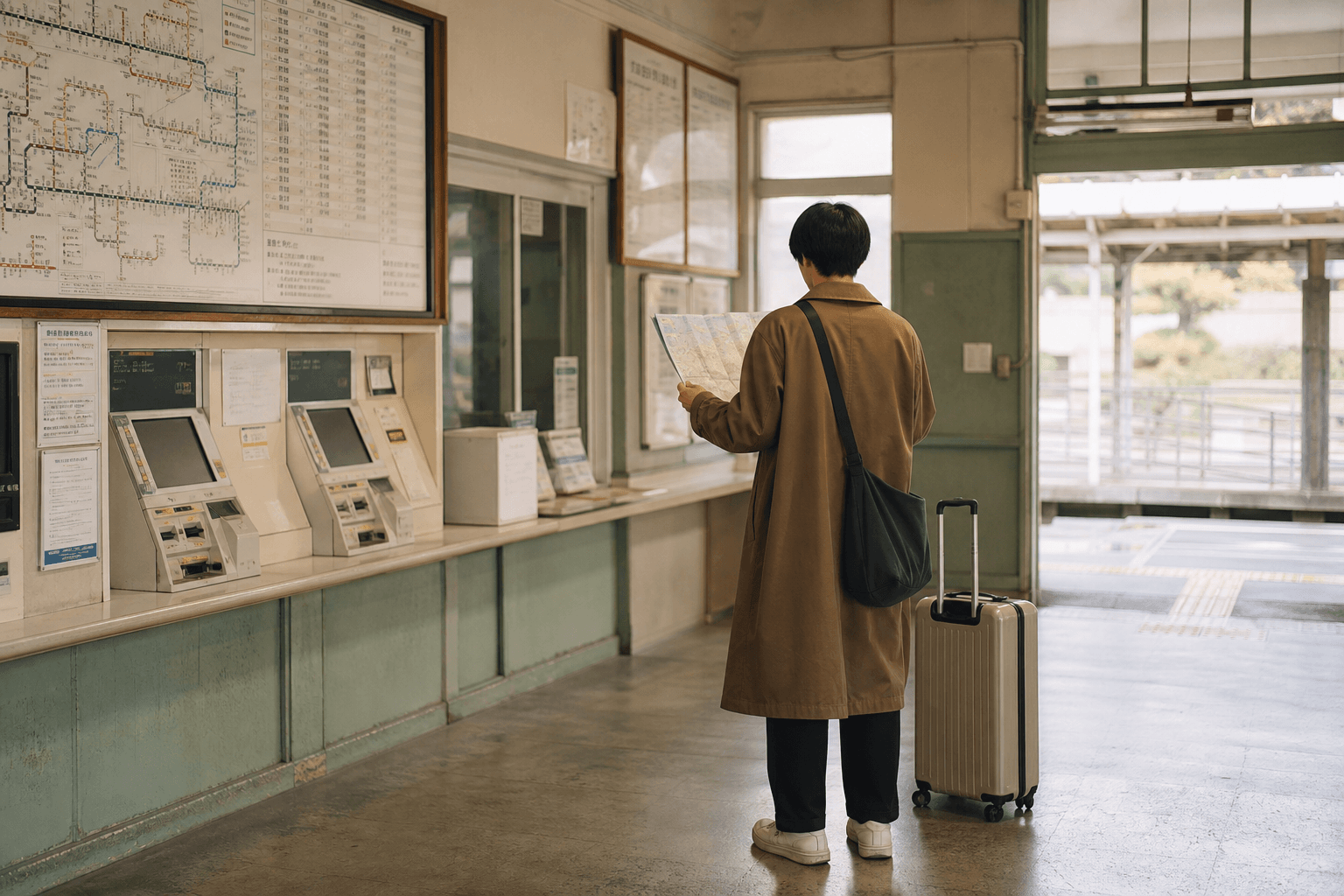
When does a Japan Rail Pass cost less than the tickets your route actually requires?
Before buying a Japan Rail Pass, many travelers count cities on a map and treat the pass as the default choice for any trip that crosses Japan. That habit is understandable. The pass is heavily discussed, easy to find online, and presented as the standard way to travel by train. It can also feel like proof that the journey will be substantial.
The pass is not a default purchase. It is a prepaid bundle for eligible JR services within a fixed number of consecutive days. Whether it saves money depends on the distance you will actually cover, the dates those journeys fall on, which trains you choose, and whether your movement stays on JR lines the pass covers.
The relevant question is not whether the pass is generally good. It is whether your actual route — not an imagined one — justifies its cost.
The nationwide Japan Rail Pass is not automatically good value.
It is worth considering when the total cost of your planned JR journeys within one consecutive 7-, 14-, or 21-day period would exceed the pass price, and when you are willing to travel on covered train categories. For many geographically concentrated trips — several days in Tokyo, a week in Kyoto and Osaka, or time in one region such as Hokkaido — individual tickets or a regional pass often cost less.
The correct decision depends on your itinerary math: add the covered JR fares you would realistically pay during the pass window, then compare that total with nationwide and relevant regional pass prices. If you have not listed your legs yet, calculate before you buy.
Start with your route, not the product. A pass does not become economical because you visit several famous cities. Distance, travel dates, covered services, train category, and consecutive validity all matter.
The nationwide pass is more likely to be worthwhile when:
You will make multiple long-distance JR journeys within 7, 14, or 21 consecutive days. Those journeys fall inside one continuous validity window, not across scattered travel days. Your route stays mainly on JR lines included in the pass. You are comfortable using Hikari, Sakura, Kodama, and other covered services, or paying the official Nozomi/Mizuho supplement when speed matters. You value one ticket for many legs, even if savings are modest.
Individual tickets are more likely to be better when:
You stay in one metro area and ride subways, city buses, or private railways more than intercity JR. Your calendar has long gaps between travel days. A 7-day pass covers seven consecutive days, not seven separate travel days across two weeks. Your route depends on non-JR lines — Hakone, many airport links, or direct private railways. Your intercity legs are few and short enough that separate tickets stay below the pass price.
A regional pass is more likely to be better when:
Your movement stays inside one part of Japan — Kansai, eastern Honshu, Kyushu, or Hokkaido — even if you travel frequently within that area. Your trip length does not match nationwide 7/14/21-day windows cleanly. A regional product covers the exact lines you will use.
If your itinerary is still taking shape, build the fare total first. Buying early for peace of mind can be expensive peace of mind.
Match the ticket product to how your route actually moves.
Nationwide Japan Rail Pass
Multiple long-distance JR journeys fall inside one 7-, 14-, or 21-day consecutive window.
Best when your route stays mainly on covered JR lines and covered train categories.
Regional pass
Travel stays concentrated in one part of Japan, even if you move frequently within that area.
Compare the specific regional product map against your legs rather than assuming a nationwide pass.
Individual tickets
Your trip is metro-heavy, widely spaced across separate travel days, or depends on non-JR lines.
Often cleaner when intercity legs are few, short, or do not cluster inside one validity window.
None of these is universally better. The fit depends on dates, distance, lines, and train category.
The Japan Rail Pass is sold jointly by the six JR Group companies. It provides unlimited travel on eligible JR services for 7, 14, or 21 consecutive days.
According to the official Japan Rail Pass site, the pass covers JR Group Shinkansen services except Nozomi and Mizuho trains on the Tokaido, Sanyo, and Kyushu lines unless you buy the separate Only With Japan Rail Pass Nozomi/Mizuho supplement ticket. Covered Shinkansen include Hikari, Sakura, Kodama, and Tsubame, along with trains on the Tohoku, Yamagata, Akita, Hokkaido, Joetsu, Hokuriku, and Nishi-Kyushu Shinkansen lines, subject to accommodation rules.
It also covers JR limited express, express, rapid, and local trains; the Tokyo Monorail; JR Miyajima Ferry; and many JR local bus routes. Highway buses operated by JR Bus are not covered. Private railways, most city subways, and non-JR airport railways require separate tickets.
Some JR trains continue onto private lines. Trips to Mount Fuji via the Fuji area, for example, may include private railway segments where additional fares apply even when part of the journey is on JR. The official route map lists exceptions.
The pass does not guarantee a seat. Reserved seats are free to book, but you must obtain a seat ticket before boarding. Some trains have no non-reserved cars.
Official online purchase prices for ordinary passes are:
7-day: ¥50,000 adult / ¥25,000 child 14-day: ¥80,000 adult / ¥40,000 child 21-day: ¥100,000 adult / ¥50,000 child
Green Car passes cost ¥70,000 / ¥110,000 / ¥140,000 for the same durations. Children are aged 6–11 at time of use. Online purchases have specific rules when a child is 11 on the payment date but 12 at time of use.
For Exchange Orders bought through overseas JR-designated agencies, the same prices apply through September 30, 2026 (local time at purchase). From October 1, 2026, overseas agency Exchange Order prices rise to ¥53,000 / ¥84,000 / ¥105,000 for ordinary 7-, 14-, and 21-day passes. Confirm current pricing on japanrailpass.net before purchase.
Eligibility (requirement ①): You must be a foreign visitor entering Japan for sightseeing on Temporary Visitor status, with the corresponding stamp or sticker in your passport. If you use an automated immigration gate and receive no stamp, use a staffed gate or ask an officer for the Temporary Visitor stamp or sticker. Trusted Traveler Program registered user card holders may show that card to confirm status instead.
You cannot pick up or use the pass on Trainee, Entertainer, Re-entry Permit, or other non–Temporary Visitor statuses. Japanese nationals living abroad are not eligible for online purchase. A separate overseas-agency path exists for qualifying Japanese residents abroad.
The pass is personal. Passport information is registered to the ticket. Carry your passport while using the pass and present it when asked.
Regional passes are separate products with their own prices, validity periods, coverage maps, and eligibility rules. They are not smaller versions of the nationwide pass.
The principle is simple: concentrated travel within one region often favors a regional pass; crossing the country in a short consecutive window often favors the nationwide pass. But you still need to compare your actual legs against that specific product's map.
Useful examples to research for your route:
JR West Kansai-area passes for Kyoto, Osaka, Nara, Kobe, and Himeji. Hokuriku Arch Pass for routes linking Tokyo, Kanazawa, and Kyoto without a full nationwide loop. JR East area passes for Tokyo and northern Honshu. JR Kyushu passes for Fukuoka and southern Kyushu travel. JR Hokkaido passes for Hokkaido regional travel.
A future Japan Atlas guide to regional JR passes will compare these products in more detail. For now, treat each regional pass as a separate calculation.
You cannot hold two nationwide passes with overlapping validity on the same passport.
Do not rely on city count or sample itineraries alone. Use this process:
1. List every long-distance JR journey you realistically expect within your intended consecutive pass period, with dates attached. 2. Look up the covered fare for each leg on an official JR fare source, using the train type you would actually ride. 3. Add seat reservation costs only where they apply outside the pass. With the pass, ordinary reserved seats on covered trains are included. 4. Exclude transport the pass does not cover: subways, private railways, airport access not on JR, and local non-JR side trips. 5. Compare the total with nationwide pass prices and with any relevant regional pass. 6. Consider convenience, not only nominal savings. Individual tickets may be simpler if you want frequent Nozomi departures, flexible one-off legs, or a route that does not cluster inside one validity window.
Illustrative example only (standard-season reserved seats on covered trains): Tokyo to Shin-Osaka ¥14,400; Shin-Osaka to Hiroshima; Hiroshima to Kyoto; Kyoto to Tokyo. Four long legs can approach a 7-day pass at ¥50,000 before shorter JR side trips are added. Your total may be lower or higher.
Small savings alone do not make the pass the better choice. If the pass saves ¥2,000 but complicates your train choices, individual tickets may be the cleaner decision.
Compare pass value from your own route, not from city count alone.
List every long-distance JR leg
Attach realistic dates inside your intended consecutive pass window.
Look up each covered fare
Use the train type you would actually ride on an official JR fare source.
Add reservation costs only where needed
Ordinary reserved seats on covered trains are included with the pass.
Exclude non-covered transport
Subways, private railways, and non-JR airport access stay outside the total.
Compare totals with pass prices
Check both nationwide and any relevant regional pass for the same route.
Weigh convenience as well as savings
A small saving may not justify a product that complicates your train choices.
Two main purchase paths exist:
Online via the official Japan Rail Pass Reservation site: Purchase with passport details and a credit card in the purchaser's name. You may buy for yourself and up to six eligible companions on the same itinerary. Reserved seats on eligible Shinkansen and limited express trains can be booked before arrival in Japan. After landing, pick up the pass at a JR-designated ticket office or certain reserved-seat ticket vending machines with your purchase reference and passport showing Temporary Visitor status. Pick up before the start date or during the validity period.
Overseas travel agencies: Buy an Exchange Order abroad, then exchange it for the physical pass at a JR exchange office in Japan with the same eligibility documents. Overseas currency pricing depends on exchange rates at issue.
Activation: Choose your first day of validity at exchange or pickup. Once started, dates cannot be changed. Align the start date with your first expensive long-distance leg, not necessarily your arrival day.
Seat reservations: Book at a Midori-no-madoguchi ticket office, Travel Service Center, reserved-seat machine, or through the online reservation site if you purchased there. Reservations are free on covered trains. Cancel before departure if plans change.
At stations: Use automatic gates where available, or present the pass at a staffed gate. Carry your passport.
Refunds: Online purchases can be refunded before the validity start date with a ¥560 handling fee per pass under official conditions. After use begins, no refund is issued.
Nozomi and Mizuho trains on the Tokaido, Sanyo, and Kyushu Shinkansen are not included in the standard pass fare. This does not mean they are unavailable to pass holders.
Pass holders may use Nozomi or Mizuho only after purchasing the Only With Japan Rail Pass Nozomi/Mizuho supplement ticket before boarding. That ticket is valid for the section and service shown on the ticket and must be used together with an active pass. Official sample supplement prices include Tokyo to Shin-Osaka or Kyoto at ¥4,960 and Tokyo to Hiroshima at ¥6,500.
For many routes, Hikari on the Tokaido line and Sakura on the Sanyo line are the simpler alternative. They are covered by the standard pass, stop more often, and may take slightly longer. If schedule flexibility matters more than maximum speed, the supplement may be unnecessary.
Add supplement costs to your itinerary calculation when you know you will choose Nozomi or Mizuho. For pass-versus-ticket comparisons, compare like with like: a pass-based trip on Hikari is not the same product as an all-Nozomi ticket plan.
Japan's rail network is primarily a working transport system for residents, not a tourist product with unlimited travel as its default setting. Commuters use IC cards and commuter passes. Intercity travelers buy point-to-point tickets or pay resident fares on specific train categories. The Japan Rail Pass is one purchasing option layered onto that network for eligible visitors.
That is why the pass has immigration conditions, fixed validity windows, and train-category limits. It bundles JR travel for concentrated long-distance movement. It is not designed for a week of subway rides in Tokyo alone, or for routes that depend heavily on private railways.
Travelers make better decisions when they plan around actual lines and dates rather than the symbolic idea of unlimited cross-country travel. The pass can be an excellent tool when the route fits. When it does not, ordinary tickets or a regional pass are not compromises. They are the correct match.
Buying the pass before listing intercity legs and dates.
Treating city count as a substitute for fare math.
Entering Japan without Temporary Visitor documentation after using automated gates.
Assuming Nozomi and Mizuho are included in the base pass price.
Activating the pass on arrival day, then spending several days in one city before long-distance travel.
Using a nationwide pass for a single-region trip when a regional pass or individual tickets would cost less.
Assuming the pass covers subways, airport private railways, or scenic non-JR lines.
Not reserving seats on busy routes during holiday or cherry-blossom travel — see Living by the Calendar for how season shapes movement.
Purchasing overlapping passes on the same passport.
Expecting refunds after validity has started.
Book reserved seats for your first long Shinkansen leg at pickup if you already know the train.
If Tokyo is your entry city, separate metro and local JR costs from intercity legs before choosing pass length.
Use Hikari rather than Kodama on the Tokaido line for through travel. Kodama stops at every station.
On westbound Tokaido–Sanyo routes, Sakura is the covered equivalent of Hikari on the Sanyo segment.
Keep passport and pass together for quick presentation at gates.
If you purchase online, reserve known legs before departure, then adjust at ticket offices if needed.
Compare costs using the same seat type across all legs.
Budget separate tickets early for non-JR side trips rather than assuming the pass will cover them.
On multi-city days, consider luggage forwarding for heavy transfer legs rather than carrying full suitcases through every station.
For platform navigation, car numbers, and boarding sequence, see How to Use the Shinkansen in Japan.
Leave room in your schedule for the trains the pass actually includes, as discussed in Planning Less, Seeing More.
Confirm Temporary Visitor eligibility and how you will obtain the correct passport stamp or sticker on arrival.
List intercity legs by date and compare the JR fare total with nationwide and regional pass prices.
Decide whether Nozomi or Mizuho speed is worth supplement fares on your route.
Choose online purchase if advance seat reservations matter; choose an overseas agency if that fits your booking process.
Set your pass start date to match your first major JR journey.
Save the official coverage map and mark any private-line segments on your route.
Carry your passport throughout the trip.
Treat the pass as a financial tool matched to a route, not proof that you are traveling seriously enough.
The Japan Rail Pass is worth buying when the math is clear: your covered JR journeys within one validity window cost more than the pass, and the trains included in that price fit your schedule.
That clarity comes from dates, routes, lines, and realistic alternatives — not from reputation. A trip can be deep and well-planned on individual tickets. A pass can be the wrong purchase on a famous itinerary. The measure is fit, not symbolism.
Match the product to the journey. Then move on to the parts of travel the pass cannot answer: where to stay, how long to remain, and what to leave unscheduled.
Key practical details in this guide were checked against the following official sources.
Information checked: July 2026
Continue exploring this way of seeing Japan.
Where tradition and restless energy move side by side.
Where tradition still shapes everyday life.

Where openness, humor, and generosity shape everyday life.

Where the sacred remains close to everyday life.
Where memory lives on beside ordinary life.

Where people have learned to live with the seasons.

Where one mountain continues to watch over the land.