Tokyo
Where tradition and restless energy move side by side.
Should you rely mainly on cash, mainly on cards, or a practical mix of both?
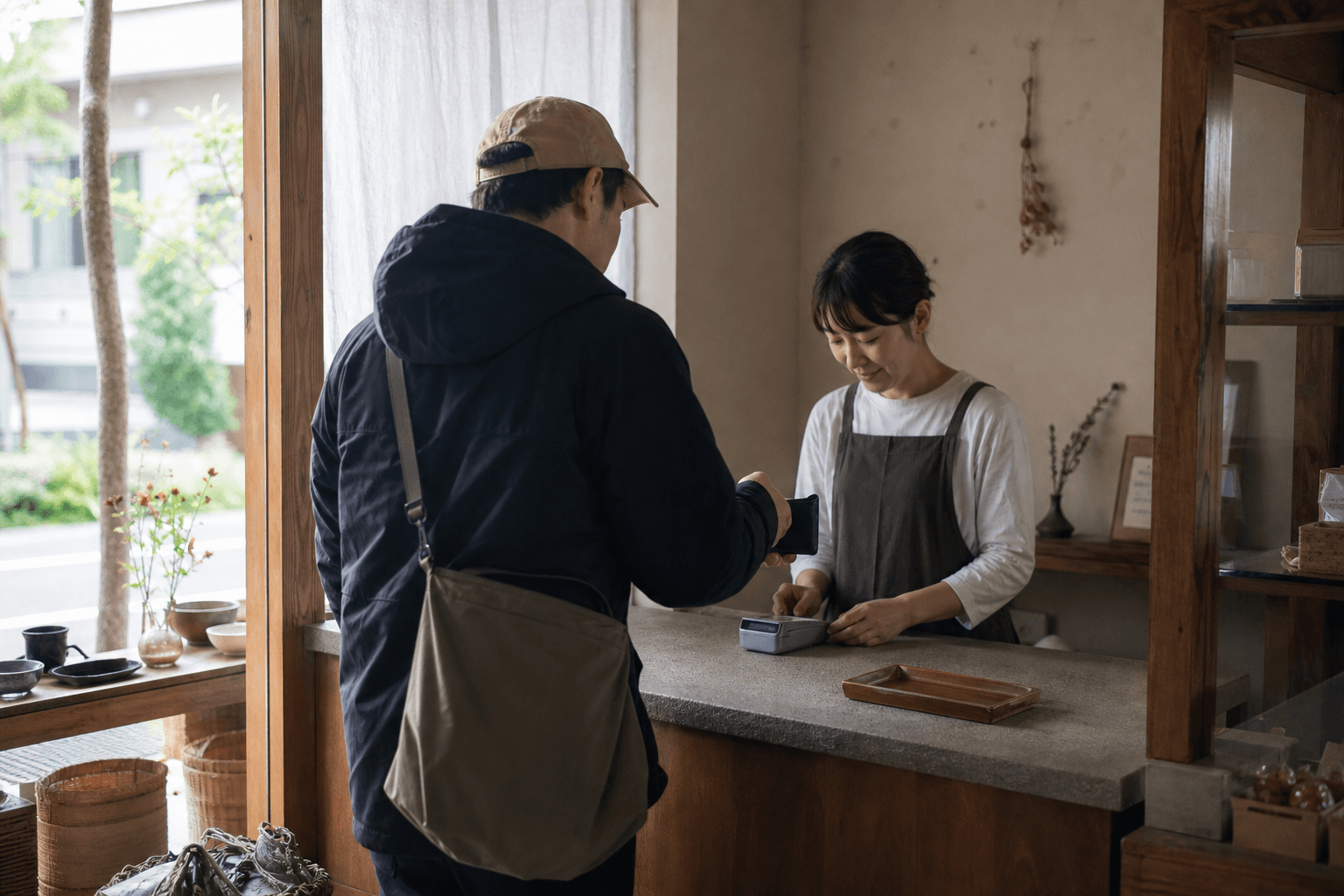
At a small restaurant counter, a traveler reaches the end of the meal and waits for the bill. The question is not philosophical. It is practical: card, cash, or the prepaid balance on an IC card if the shop accepts it.
That moment repeats all day — at a convenience store, a museum desk, a mid-range hotel, a rural bus, a temple entrance. Japan is neither a cash-only country nor a place where you can ignore cash entirely. Card acceptance has expanded quickly in cities, but the system still has gaps.
The useful question is not which method is more modern. It is which combination keeps your trip moving without carrying more cash than you need or assuming a card will work everywhere.
Most first-time visitors should plan to use both cash and cards.
Bring a widely accepted credit or debit card — usually Visa or Mastercard — for hotels, larger restaurants, department stores, airport services, and many chain businesses. Keep a moderate amount of Japanese yen for small shops, rural stops, temple fees, vending machines, and places that simply do not take cards.
Add an IC card for everyday urban spending: trains, subways, buses, convenience stores, and many small purchases under about ¥1,000.
According to JNTO, international credit, debit, and prepaid cards are generally accepted across Japan, though some shops do not display card logos and short-distance train fares often still require cash, IC cards, or separate tickets. JNTO also notes that cash remains advisable during your stay, even as card use grows.
The best setup for many trips: one card, one IC card, and enough cash to cover a few days of small purchases — not a large unused stack.
Payment choice in Japan is usually about coverage, not loyalty to one method.
Mostly cash can make sense when:
You are visiting many rural areas, small family restaurants, or festival stalls. You prefer never wondering whether a shop accepts cards. You are uncomfortable relying on ATM access during evenings or holidays. Your daily spending is mostly small amounts where cash is faster than card terminals.
Mostly card can make sense when:
You stay mainly in major cities such as Tokyo, Kyoto, or Osaka. Your hotels, intercity tickets, and larger purchases are already card-friendly. Your bank card has low foreign-transaction fees and contactless works reliably. You are comfortable withdrawing yen only occasionally.
Use both when:
You want the simplest real-world setup for a first or second trip. You will move between cities, convenience-store breakfasts, temple visits, and mid-range dinners in the same week. You already plan to use an IC card for transport and small urban purchases. You want card convenience without being stranded at a cash-only rural stop.
Neither cash nor card is universally better. Flexibility is the point.
Choose the mix that matches where you will actually spend money.
Mostly cash
Your route is rural-heavy or you prefer never checking card acceptance.
Works when ATM access is planned and you accept carrying more physical yen.
Mostly card
Your trip stays in major cities and your card has reliable acceptance and low fees.
Still keep some yen for the shops and services cards do not cover.
Use both
You want the practical default for a mixed city-and-side-trip itinerary.
Card for larger purchases, IC card for daily urban taps, cash for the gaps.
No single method covers every purchase in Japan. The fit depends on your route and spending pattern.
Japan's payment landscape changed faster in the 2020s than older travel advice suggests. Contactless cards, QR-code apps, and IC-card payments are common in cities. Hotels, airports, department stores, and chain restaurants increasingly take international cards.
Cash has not disappeared. It remains normal at small independent restaurants, some shrines and temples, local buses, market stalls, and older businesses that never installed card terminals. JNTO still describes Japan as a society where carrying cash is advisable.
For travelers, three layers usually matter:
Cash yen for universal acceptance where other methods fail. Credit or debit cards for larger, card-ready businesses and online bookings. IC cards for transport and many everyday low-value purchases, as explained in IC Cards in Japan.
Mobile wallets and Japan-only QR apps such as PayPay are widely used by residents, but setup for short visitor stays is often more trouble than it is worth unless you already know you need them.
Do not plan around one outdated stereotype. Plan around the mix of places you will actually enter.
According to JNTO, credit, debit, and prepaid cards from international brands are generally accepted throughout Japan, though stores may not display acceptance marks. When unsure, ask before ordering.
Cards commonly work at:
Major hotels and many business hotels. Department stores, electronics chains, and large retailers. Many chain restaurants and cafés in cities. Airport services and some long-distance rail purchases — JNTO notes cards can be used for Narita Express and shinkansen fares booked through JR channels, though not all short-distance urban train fares. Online bookings made before arrival.
Cards are less reliable at:
Tiny independent restaurants and bars. Rural shops and accommodations. Some temple and shrine counters. Vending machines and coin lockers without IC or cashless readers. Businesses that look cash-only even in cities.
Contactless tap-to-pay is increasingly available, but never assume every terminal supports it.
American Express, Discover, and Diners Club work at many tourist-oriented businesses, but acceptance is narrower than Visa and Mastercard. JNTO links to major network sites for issuer-specific guidance.
Cash, cards, and IC cards solve different payment problems — not the same one.
| Criteria | Cash | Card | IC card |
|---|---|---|---|
| Best for | Small shops, rural stops, temple fees, and cash-only tills | Hotels, larger restaurants, department stores, and pre-booked tickets | Urban trains, convenience stores, vending machines, and small daily purchases |
| Acceptance | Accepted nearly everywhere that sells to the public | Broad in cities and chains; weaker at tiny independents | Strong in major cities; not universal on every line or shop |
| Speed | Fast when exact change is ready; slower if large notes need change | Fast when contactless works; can require PIN or signature | Very fast for transport gates and tap payments |
| Typical situations | Market stalls, local buses, older cafés, shrine offerings | Hotel checkout, airport purchases, chain dining, online bookings | Subway hops, konbini snacks, locker payment, quick city errands |
| Things to remember | Carry smaller notes for small purchases; ¥10,000 notes are normal but change can take time | Ask if unsure; foreign fees and DCC prompts may apply | Not a credit card; load prepaid value and keep some cash for non-IC places |
Best for
Acceptance
Speed
Typical situations
Things to remember
Most trips use all three at different moments. None replaces the others entirely.
Cash remains the fallback that still works when everything else fails.
Keep yen on hand for:
Small restaurants and bars that do not display card logos. Temple, shrine, and some museum counters. Local buses when IC is unavailable or exact fare is required — see Taking the Bus in Japan. Coin lockers and vending machines without IC readers. Tipping is not customary in Japan, but cash is still used for donations, offerings, and some services. Markets, festival stalls, and older shopping streets.
JNTO recommends carrying cash during your stay even when cards are available. That does not mean withdrawing huge amounts at once. It means not arriving in a countryside town assuming card-only travel.
How much to carry depends on your day. Many city travelers do well with roughly ¥10,000–¥20,000 in a wallet for incidental spending, then withdraw more when needed. Rural multi-day stretches may require more.
Coins matter in Japan. ¥1, ¥5, ¥10, ¥50, and ¥100 coins accumulate quickly at vending machines and small purchases. A small coin pouch reduces friction.
How much yen to keep on your person while moving between cities is partly a packing question — see What to Pack for Japan if you are deciding what stays in a day pack versus checked luggage.
An IC card is not a replacement for cash or a credit card. It is prepaid electronic money for everyday movement and small purchases.
Use an IC card when:
You are tapping through subway and city rail gates in Tokyo, Kyoto, or Osaka. You are buying drinks, snacks, or quick items at convenience stores that accept IC payment. You want fewer small cash transactions during a dense city day.
Do not use an IC card as your only payment method. It does not cover:
Most sit-down restaurant bills. Hotel checkout. Long-distance Shinkansen tickets unless you are paying a fare component that explicitly accepts IC in that context — many intercity legs still require reserved tickets or pass handling through Japan Rail Pass or separate tickets. Rural areas with limited IC acceptance.
JNTO specifically suggests Suica or PASMO as a useful alternative to carrying large amounts of cash for transport, convenience stores, and an increasing number of shops and restaurants — while noting they cannot be used everywhere.
If you already plan an IC card, treat cash and a bank card as companions, not competitors.
Most Japanese bank branch ATMs do not serve foreign cards reliably. Travelers should plan around a few accessible networks.
The most useful for visitors:
Seven Bank ATMs in 7-Eleven convenience stores — available at more than 28,000 locations nationwide, with multilingual screens for overseas-issued cards. Japan Post Bank ATMs — located nationwide, often in post offices and also at some stations and supermarkets; English service available per JNTO. Major airport ATMs at Narita, Haneda, Chubu Centrair, Kansai, Fukuoka, and Naha.
Less common but possible:
Selected Mizuho, MUFG, and Sumitomo Mitsui bank branches for international card withdrawals, per JNTO currency guidance. Lawson Bank and other convenience-store ATM networks may exist in specific locations.
Practical search strategy:
Use 7-Eleven first in cities. Use Japan Post Bank when the nearest post office or Japan Post ATM is closer. Withdraw at the airport on arrival if you want immediate yen before leaving the terminal — see Airport Arrival Guide: Your First Hours in Japan for where cash fits in the first hour after customs. Do not assume every ATM in a station accepts foreign cards.
Your home bank card and your merchant acceptance card are two different questions.
For spending in shops, JNTO states that international-brand credit, debit, and prepaid cards are generally accepted across Japan. Visa and Mastercard are the safest default pair for visitors. JNTO also lists American Express, JCB, Discover, and Diners Club resources for travelers who carry those products.
For ATM withdrawals, check both:
Whether the ATM network accepts your card brand. Whether your issuing bank allows Japan ATM withdrawals and charges foreign fees.
Seven Bank lists usable overseas card marks including Visa, Mastercard, UnionPay, American Express, JCB, Discover, and Diners Club, with brand-specific service hours on some networks. Japan Post Bank lists Visa, Plus, Mastercard, Maestro, Cirrus, JCB, China UnionPay, and Discover.
Some cards may not work even when the logo appears. JNTO and Seven Bank both note that acceptance ultimately depends on the issuing institution. Test your card early in the trip at a convenience-store ATM or a known card-friendly shop.
Contactless and mobile-wallet compatibility varies by card issuer, phone model, and merchant terminal.
When you need more yen, use an ATM designed for international cards and read the fee screens carefully.
Seven Bank:
Overseas cards can withdraw Japanese yen at 7-Eleven ATMs day or night at many locations. Per-transaction withdrawal limit is ¥100,000 for most overseas cards, or ¥30,000 for magnetic-stripe cards. Screens, receipts, and guidance are available in multiple languages. Seven Bank offers Dynamic Currency Conversion on some transactions — you may be asked to choose Japanese yen or your home currency. Choosing yen is often safer so your bank, not the ATM, handles conversion. Fees for overseas cards vary by card brand.
Japan Post Bank:
Overseas-issued cards can withdraw at Japan Post Bank ATMs nationwide. Per-transaction limit is ¥50,000. An ATM usage fee of ¥220 (tax included) may apply for some overseas cards, in addition to issuer fees. Balance inquiry is not available on the international ATM service.
JNTO notes that ATM service fees may apply depending on time and day, and not all ATMs operate 24 hours. In busy central areas, machines can occasionally run low on cash.
Withdraw a few days' worth of spending rather than one large lump sum unless your bank charges per withdrawal.
Assuming Japan is cash-only because of old forum posts.
Assuming Japan is card-only because of city hotel convenience.
Carrying one large withdrawal for the entire trip instead of refreshing modest amounts.
Using a bank card at a local branch ATM that does not accept foreign cards.
Choosing home-currency DCC at an ATM without comparing issuer rates.
Forgetting that short-distance train and subway fares often need IC cards, cash, or separate tickets even when a Japan Rail Pass covers long-distance legs.
Treating an IC card like a credit card with unlimited tap-and-go everywhere.
Not asking whether a small restaurant takes cards before sitting down.
Running out of cash in rural areas with no nearby 7-Eleven or post office ATM.
Declining to carry any cash because contactless worked on day one in Tokyo.
Load an IC card early and keep some cash before leaving the airport area.
Carry at least two payment layers: a bank card plus yen, with an IC card for city days.
Test one ATM withdrawal and one card purchase on your first day in Tokyo or your arrival city.
Keep a few ¥1,000 notes for small purchases; they are easier than paying ¥300 with a ¥10,000 note.
Use 7-Eleven or Japan Post Bank ATMs when possible rather than random branch machines.
Check whether your bank charges foreign ATM fees, foreign transaction fees, or both.
Photograph the front and back of your card separately from your wallet, and store issuer emergency numbers.
If you are forwarding luggage between hotels, keep payment cards, cash, and passport in your day bag — see luggage forwarding in Japan.
For everyday purchases at convenience stores — what they solve, what they do not — see Convenience Stores in Japan.
At sit-down restaurants, payment timing and format vary by shop type — see Japanese Restaurants Explained for pay-before versus pay-after patterns before your first meal out.
Leave room in your budget planning for seasonal crowds and slower ATM access during busy travel weeks — see Living by the Calendar.
Japan's payment habits are often described in cultural terms — cash-loving, meticulous, resistant to change. That story is incomplete.
What looks traditional is often logistical. Small shops avoided card fees. Rural banks had limited networks. Transport systems were built around prepaid cards because they move millions of people quickly through gates. Temple counters still take cash because the transaction is simple and the infrastructure was never upgraded.
The recent expansion of cards and contactless tools is less about rejecting cash than reducing friction where volume is high: airports, chains, hotels, convenience stores, and urban transport hubs.
For travelers, the lesson is practical. You are not choosing between old Japan and new Japan. You are matching payment method to the place you are standing in: a chain café in Osaka, a shrine in Kyoto, a subway gate, a family-run lunch counter. Convenience changes by location, not by national personality.
Tell your bank you are traveling to Japan if your issuer recommends travel notices.
Confirm your card works internationally and note ATM and foreign-transaction fees.
Decide whether you will use a physical or mobile IC card and read IC Cards in Japan before arrival.
Plan to arrive with some yen or withdraw at the airport ATM immediately.
Identify your fallback ATM network: 7-Eleven or Japan Post Bank.
Do not budget for zero cash unless your itinerary is almost entirely urban and card-ready.
Keep one payment card and cash in separate places in case of loss.
Match payment planning to your actual route rather than to generalizations about how Japan used to pay — as with rail and luggage choices, fit matters more than reputation, as discussed in Planning Less, Seeing More.
Cash or card in Japan is not a contest with one winner. It is a travel logistics question: which method keeps each day moving with the least friction.
For most international visitors, the answer is both. Use cards where they are clearly accepted. Use an IC card for everyday urban movement. Keep enough yen for the places that still run on cash because the transaction is small, the shop is old, or the town is remote.
Payment should fade into the background of the trip. When you have the right mix, you stop thinking about how to pay — and start thinking about where to go next.
Continue exploring this way of seeing Japan.