Public Toilets in Japan: Where to Find Them and How to Use Them
Where can you reliably find a toilet, and what should you expect once you are there?
- Category
- Travel
- Central Question
- Where can you reliably find a toilet, and what should you expect once you are there?
The train from the airport has already delivered you to the city. Hotel check-in is still an hour away. Your bag is manageable, but the morning is long — coffee helped, then water, and now the next practical question is simpler than any sightseeing plan: where is the restroom, and will it be straightforward once you find it?
That moment arrives on almost every Japan trip. Not as a cultural puzzle. As ordinary travel logistics between one obligation and the next.
Public toilets in Japan are widely available in cities and along major travel corridors — but availability, layout, and supplies are not identical everywhere. A major station concourse, a department store, a park kiosk, and a convenience store on the same block can each answer the question differently.
The useful approach is not to memorize toilet types or chase novelty. It is to know where facilities tend to be reliable, what symbols and layouts usually mean, and how to use shared restrooms calmly so the stop disappears back into the day.
The Short Answer
Public toilets in Japan are easy to find at train stations, department stores, parks, and tourist facilities in most cities, and the majority are free — no coins or tokens required.
Stations and larger commercial buildings are usually the most reliable first stop. Convenience stores can help too, but access varies by branch, so do not count on a konbini toilet being open to customers — see Convenience Stores in Japan for what those stops reliably solve and what they do not.
Most fixtures are Western-style seated toilets, though squat-style toilets still appear at some older or rural facilities. Many seated toilets include a washlet-style control panel for a heated seat and water spray — if the buttons are unfamiliar, read the icons before pressing anything; you do not need to use any of them.
Toilet paper is usually provided and is meant to go in the bowl, not a separate bin — a small bin beside the toilet, when there is one, is for sanitary items only. Carry a small tissue packet as backup at smaller or older facilities.
Multipurpose or accessible toilets, marked with universal-access symbols, are reserved for people who need their equipment — wheelchair users, caregivers with children, and others who rely on handrails, changing platforms, or ostomate fixtures. Use a standard cubicle when you do not need those features, and leave multipurpose rooms ready for the next person who does.
Practical expectations for finding and using public toilets on an ordinary travel day.
- Most reliable first stops
- Stations and larger commercial buildings often offer the steadiest access on travel days.
- Major hubs usually post clear signage; smaller stations may place restrooms inside the ticket gate.
- Convenience stores
- Toilet access varies by branch, layout, and local policy.
- Do not assume every konbini offers a public customer restroom.
- Facilities and supplies
- Layout, soap, dryers, and paper are not identical from place to place.
- Carry a small tissue packet as backup, especially at parks or older facilities.
- Symbols and signage
- Follow restroom signs and accessibility pictograms carefully.
- Multipurpose toilets are for people who need their equipment — use standard cubicles when you do not.
- Small backup
- A pocket packet of tissues costs little and helps at smaller stops.
- Before you leave
- Return the seat, fold changing platforms down, and replenish paper when you can.
- Leave the space ready for the next person.
This is a confidence guide for ordinary travel days — not a survey of toilet technology.
Where to Find Public Toilets in Japan
Think in layers — from the most travel-relevant to the most situational.
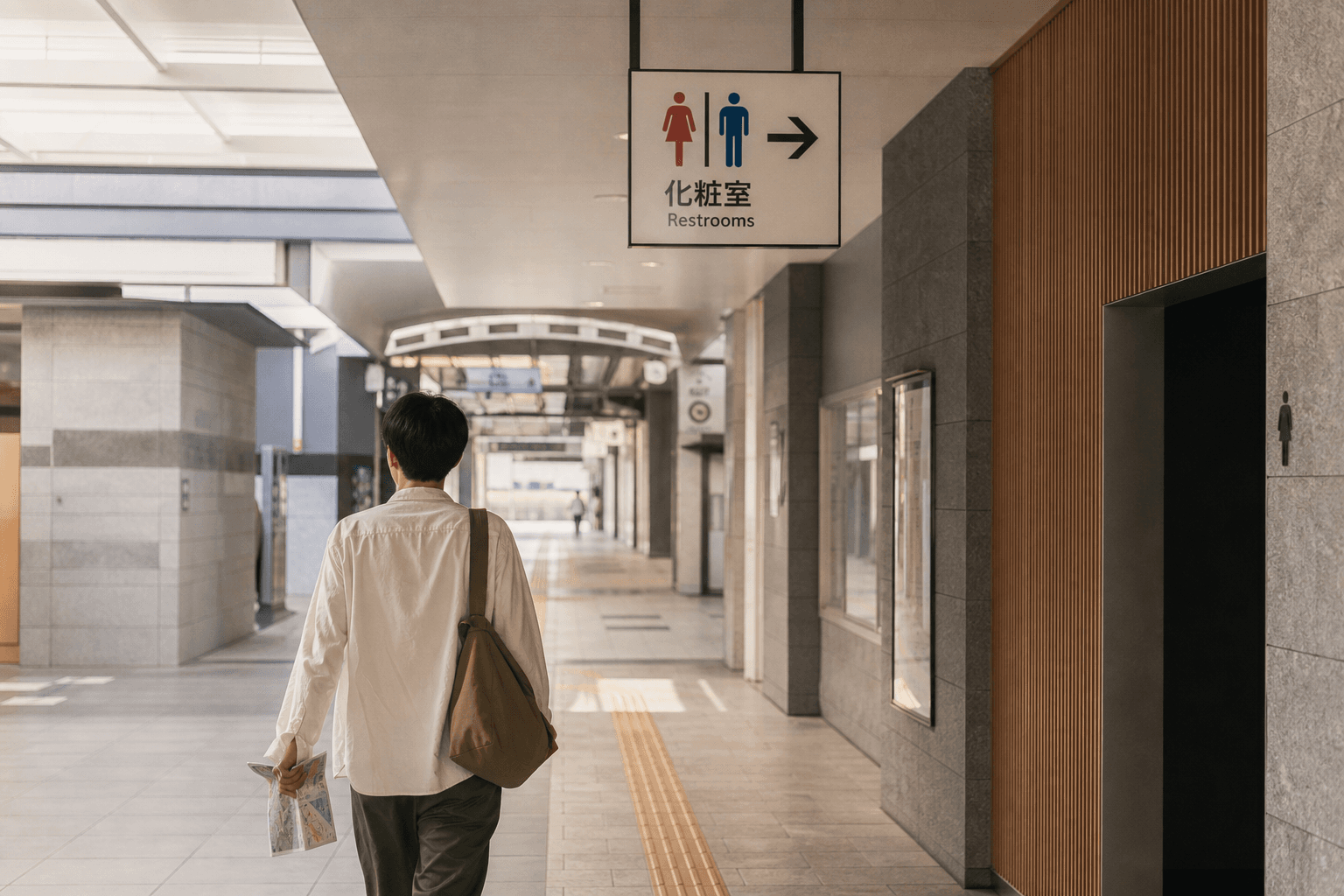
Restroom signage almost always uses recognizable pictograms, and often the Japanese words トイレ (toire), お手洗い (otearai), or 化粧室 (keshōshitsu) — all common ways to say "restroom."
Stations are the practical first choice on many days. JNTO notes that major stations have signed restrooms, and JR East documents barrier-free equipment at many facilities. Tokyo Metro and other operators maintain multi-functional restrooms at numerous metro stations. When you are already moving by train, following platform or concourse signage is often faster than detouring to an unrelated shop.
Department stores and large shopping complexes are reliable when you are already inside for errands, lunch, or shelter from weather. They tend to maintain staffed building standards and clear floor maps — useful when a nearby convenience store cannot help.
Parks, museums, tourist information centers, and municipal facilities often provide free public toilets. Kyoto City operates a mapped public-toilet network across the city; many locations are free to use. Smaller neighborhood parks may have simpler facilities with fewer supplies.
Convenience stores can help when the branch allows customer access — but that access is not universal. Treat konbini restrooms as a bonus, not a plan.
Hotels, restaurants, and cafés may allow restroom use for customers. Asking politely is normal; assuming walk-in access without purchase is less reliable.
On intercity days, pair station planning with How to Use the Shinkansen in Japan — long concourse walks are easier when you know where the signed facilities sit relative to your platform. On local bus days in Kyoto or Tokyo, Taking the Bus in Japan helps you read stop geography so you know when to use a hub station before boarding a slow corridor.
What You'll Typically Find Inside
Facilities differ by age, location, and building type — but a few patterns repeat often enough to reduce surprise.
Western-style seated toilets are common at major stations, airports, department stores, and newer public buildings. Squat-style fixtures still appear at some older facilities and in more rural areas — not as a tourist attraction, but as an ordinary layout you may encounter once or twice on a longer route.
Toilet paper is usually provided at major facilities. JNTO recommends carrying tissues as backup, particularly at small parks or remote stops where replenishment may be slower.
Multipurpose toilets — sometimes labeled as universal-access or barrier-free — may include handrails, a baby chair or changing platform, diaper-changing space, and in some locations ostomate-compatible equipment. Equipment sets vary; do not assume every multipurpose room includes every feature.
Kyoto City asks visitors to flush only the toilet paper provided in the facility and not to remove paper from dispensers. Tokyo's Anyone in Tokyo accessibility guidance similarly emphasizes leaving multipurpose facilities ready for those who need them.
Hand-washing areas may offer liquid soap, foam soap, or none at all. Dryers, paper towels, and cloth towel rollers appear in different combinations. A small handkerchief or travel towel in your day bag covers gaps without drama.
The Japan Tourism Agency and MLIT promote responsible use of public facilities — dispose of paper and waste as posted, keep shared areas clean, and avoid treating restrooms as photography subjects or curiosity stops.
Using Shared Facilities
Most anxiety comes from uncertainty, not from complex rules. The sequence is readable once you know what to look for.
Follow restroom signage first — pictograms for men, women, multipurpose access, and sometimes nursing or baby-care rooms. At stations, signs often appear on concourses before you reach the door.
Check which facilities are available and whether a queue has formed. Peak hours at major hubs can mean a short wait; multipurpose rooms may be single-occupancy with a lock indicator.
Use the correct cubicle or shared area. Standard stalls serve most visitors. Multipurpose toilets are priority spaces for people who need their layout — wheelchair access, changing platforms, or caregiver space. If you do not need those features, use a standard stall.
Dispose of paper and waste as indicated. Toilet paper belongs in the bowl at most facilities; sanitary items may have a separate small bin in the cubicle. Follow posted instructions when they differ.
Wash and dry hands using what is provided. If soap or dryers are missing, hand sanitizer from your day bag is enough to continue the day.
Before leaving, return the seat to its default position if you changed it, fold down changing platforms, and replenish toilet paper if the roll is nearly empty and a spare is reachable. Leave the space ready for the next person — the same consideration Japanese Etiquette Explained describes for other shared spaces.
If a fixture or button is unfamiliar, read the pictograms on the panel before experimenting. You do not need to understand every label to use the room safely.
A calm sequence for using shared restrooms on an ordinary travel day.
Follow restroom signage
Use posted pictograms to find the correct entrance — men's, women's, multipurpose, or family facilities.
Check available facility and queue
Read the door indicator or queue line before entering; multipurpose rooms may be single-occupancy.
Use the correct cubicle or shared area
Choose a standard stall unless you need multipurpose equipment such as handrails or a changing platform.
Dispose of paper and waste as indicated
Follow posted guidance for toilet paper and any separate sanitary disposal bin.
Wash and dry hands using what is provided
Soap, dryers, and towels vary; hand sanitizer in your bag covers gaps when supplies run short.
Leave the space ready for the next person
Reset the seat, fold changing platforms, and replenish paper when you can before you go.
Shared restrooms reward the same calm attention you bring to queues and platforms.
Accessibility and Family Facilities
Accessibility in Japan is uneven by location — improving in major cities and at many rail hubs, but not uniform at every stop on your route.
Go Tokyo notes that most metro stations in Tokyo are wheelchair accessible, with elevators, ramps, or other barrier-free routes at many locations. Tokyo Metro documents multi-functional restrooms at numerous stations — often combining accessible layout with baby-changing equipment.
JNTO states that about 95 percent of stations are accessible — a useful national picture, though individual toilet rooms still vary in size, equipment, and maintenance. Treat that figure as context for rail travel generally, not as a guarantee about every cubicle on your specific line.
Multipurpose toilets are priority facilities. Kyoto City and Tokyo accessibility guidance both emphasize that these rooms serve wheelchair users, people with ostomies, caregivers with children, and others who rely on specialized equipment. Using them when you do not need those features delays someone who does.
Family travelers will find diaper-changing tables at many major Tokyo stations per Go Tokyo, and baby rest areas at some JR East hubs. Nursing rooms may be separate from standard restroom banks — follow signage for 授乳 or baby-care symbols.
Lookup tools can help before you travel — station accessibility maps, municipal toilet locators, and operator apps — but this article does not replace those live resources. Mention them in planning; confirm on the ground when a specific stop matters for your party.
If mobility equipment, stroller size, or caregiver needs shape your day, pair restroom planning with Where to Stay in Tokyo or Where to Stay in Kyoto — hub proximity reduces repeated long concourse walks between sights and facilities.
Station Toilets
Stations deserve their own section because they are where travelers most often look first — and where gate location matters.
Major hubs such as Tokyo Station, Shinjuku, Kyoto Station, and Osaka Station typically place signed restrooms on concourses, near ticket gates, or on paid-platform levels. Signage usually appears before you commit to a long platform walk — worth noticing on transfer days.
Inside versus outside the ticket gate: at many large stations, restrooms exist on both sides. If you have not yet entered the paid area, look for facilities in the free concourse first. At smaller stations, toilets may sit inside the gate — which can mean purchasing a platform ticket or holding a valid fare to reach them, as JNTO notes for some locations.
JR East documents barrier-free toilets, nursing rooms, and multipurpose equipment at many facilities along its network. Equipment varies by station age and renovation schedule — not every hub has every feature, even within the same operator family.
During Shinkansen travel, use major transfer stations for longer comfort stops rather than assuming every intermediate platform will offer the same facility quality. How to Use the Shinkansen in Japan covers platform timing; restroom stops fit naturally into those transfer windows.
Peak commute hours can mean queues at central Tokyo restrooms. Allow a few extra minutes before a timed departure rather than treating the stop as instantaneous.
If you are storing luggage at a station — see Using Coin Lockers in Japan — plan restroom access relative to the locker bank you chose. Large hubs separate those functions across floors or concourses.
Convenience Stores and Shops
Shops fill gaps when you are already inside — but they are less predictable than stations for restroom access alone.
Convenience stores vary by branch. Some offer customer restrooms near the back or side entrance; others do not provide public access at all. Layout, franchise policy, and local building rules all play a role. The konbini article states this plainly: do not walk in expecting a toilet.
When a store does allow access, treat it as a brief courtesy stop — not a substitute for station facilities on a day built around trains. Buy nothing out of obligation, but recognize that the branch is a retail space first.
Department stores, shopping malls, and large electronics retailers in city centers usually maintain clear restroom maps on each floor. These are often the calmest option when you are already shopping or escaping weather — and more reliable than guessing about a konbini on the corner.
Roadside service areas on expressways and some highway bus rest stops provide restrooms for travelers — useful on overland legs, though this article focuses on city and rail days rather than motorway specifics.
Payment needs are separate from restroom access. If you withdraw cash or buy water while solving the same gap, see Cash or Card in Japan and Convenience Stores in Japan for what registers and ATMs typically accept.
Common First-Time Questions
Do I need coins or tokens?
Most public toilets are free, per JNTO. Some older facilities or standalone roadside units may still charge a small fee — signage usually states this at the entrance. Station restrooms at major hubs are typically free even when located inside the paid area.
Are toilets clean enough to rely on?
Major stations, airports, department stores, and municipal facilities are generally well maintained. Older park facilities or remote stops may be simpler. The practical standard is functional and usually clean — not identical to every previous room.
What if there is no toilet paper?
Paper is usually provided at major facilities. JNTO recommends carrying tissues as backup. Pocket packets are sold at convenience stores and kiosks if you forgot to pack them — see What to Pack for Japan for how small backups fit a light bag strategy.
Can I use the multipurpose toilet?
Use it when you need its equipment — wheelchair space, handrails, changing platform, ostomate fixtures, or caregiver room. If a standard stall serves your needs, use that instead so multipurpose rooms stay available for those who require them.
What about squat toilets?
You may encounter them at older or rural facilities. Face the hood, hold the rail if provided, and place belongings where they will not contact the floor. They are uncommon at major hubs but not extinct on longer routes.
Do convenience stores always have toilets?
No. Availability varies. Stations and larger buildings are safer first choices when the need is urgent.
Is it rude to use a hotel or restaurant toilet without buying anything?
Policies vary. Cafés and restaurants usually expect customer use. Hotels may restrict non-guest access. Asking staff briefly is acceptable when unsure.
Practical Tips
Notice restroom signs when you enter a station concourse — even if you do not need one yet. Memory of location beats a later urgent search.
Carry a pocket packet of tissues and a small hand sanitizer. Both are lightweight and solve the most common supply gaps.
Use major hub transfers for comfort stops on Shinkansen days — fifteen minutes between trains is enough when you already know where the signs point.
Before boarding a long bus leg, use the terminal or last major station you pass — Taking the Bus in Japan notes that rural routes offer fewer mid-journey options.
If traveling with children, identify nursing and diaper-changing symbols early at hubs you will repeat — Tokyo Station, Kyoto Station, and your hotel neighborhood station are sensible anchors.
Leave multipurpose toilets ready: reset seats, fold platforms, replace paper when possible.
Download operator or municipal locator tools before your trip if accessibility or family equipment is non-negotiable — then confirm on arrival.
Pair hub-based hotel choices with facility access — Where to Stay in Tokyo and Where to Stay in Kyoto both discuss station proximity for reasons that include concourse infrastructure.
When konbini stops solve food or cash needs but not restrooms, continue to the station or department store without treating the miss as an emergency — see Convenience Stores in Japan for the full picture of what konbini reliably offers.
Why Good Public Facilities Make Travel Easier
Clean, findable restrooms are invisible infrastructure — noticed only when they fail.
Japan invested heavily in public sanitation for residents, commuters, and visitors moving through dense cities. That investment shows up as signed station banks, municipal park networks, and maintained commercial-building facilities — not as a tourism marketing theme, but as ordinary civic function.
For travelers, the effect is practical. A long train day, a morning before hotel check-in, a child who needs a stop before a temple climb — each becomes manageable when you trust that the next major hub will probably help.
That trust should stay qualified. Not every corner offers the same quality. Rural stretches, small park stops, and uncertain konbini access still reward modest preparation — tissues, time, and knowing which layer to try first.
When facilities work, they remove a background worry. Attention returns to the itinerary: the museum block, the neighborhood walk, the reservation hour. That is the correct relationship — restrooms as solved logistics, not as trip content.
The same logic applies to other daily infrastructure this library covers — IC cards for gates, convenience stores for small gaps, coin lockers for hands-free hours. Each system reduces friction so the journey stays visible.
Before You Go
Pack a pocket tissue packet and optional hand sanitizer — light backups that matter most at parks and older stops.
Skim JNTO guidance on public toilets and barrier-free travel if anyone in your party uses mobility equipment or a stroller daily.
If Kyoto is on your route, note Kyoto City's public-toilet map for planning long walking days in the historic east and west.
Identify the major hub you will pass most often — arrival station, hotel neighborhood stop, Shinkansen transfer — and notice restroom signage on day one rather than day four.
Save an accessibility or toilet-locator app from your primary rail operator if you rely on multipurpose facilities — confirm features on the ground rather than trusting memory alone.
Read Convenience Stores in Japan so konbini expectations stay realistic alongside station planning.
Leave room in the itinerary for ordinary stops, as Planning Less, Seeing More suggests — a five-minute facility pause is normal travel rhythm, not lost time.
Public toilets in Japan are less a mystery than a logistics layer — findable at most major travel points, variable in detail, and manageable with modest preparation.
Start with stations and larger buildings when you need reliability. Read signage and pictograms before you choose a cubicle. Carry small tissue backup. Leave shared spaces ready for the next person.
When the stop works, you forget it happened. That is the point. The afternoon belongs to the city again — the museum, the neighborhood lunch, the train you meant to catch — and the morning's practical question stays solved behind you.
Sources and verification
Key practical details in this guide were checked against the following official sources.
- JR East — Accessibility
- GO TOKYO — Accessible Tourism
- Kyoto Travel — Maps and Tools
- JNTO — Accessible Tourism
Information checked: July 2026
Related Reading
Continue exploring this way of seeing Japan.
- Convenience Stores in Japan: What Travelers Can Actually Use Them For
- Japanese Etiquette Explained: Everyday Cues for First-Time Visitors
- Where to Stay in Tokyo: Choosing the Neighborhood That Fits Your Trip
- Where to Stay in Kyoto: Choosing the Neighborhood That Fits Your Trip
- Taking the Bus in Japan: A First-Time Guide
- How to Use the Shinkansen in Japan
- Cash or Card in Japan?
- Planning Less, Seeing More