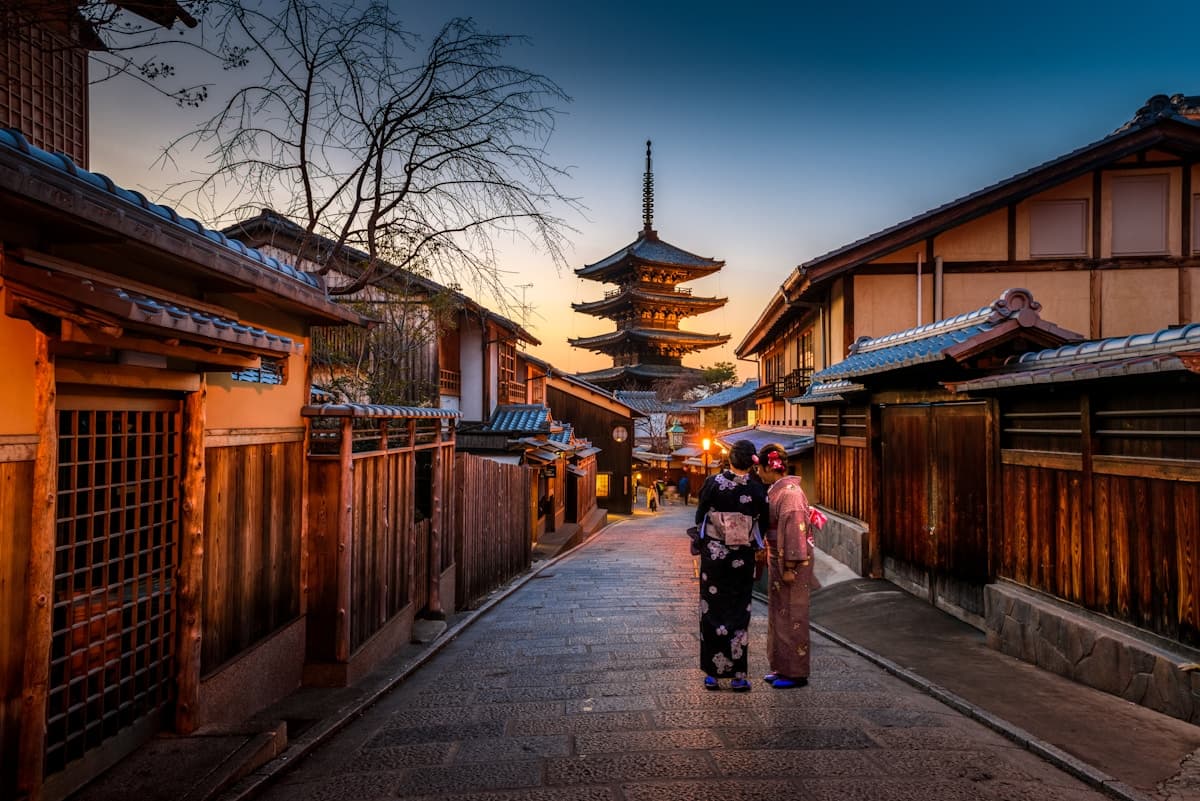
Tokyo
Where tradition and restless energy move side by side.
Why is silence sometimes more generous than certainty?
A request is made. The answer does not arrive as refusal. No one says the word that would close the matter cleanly. Instead, there is a pause — brief, but not empty — and then a phrase that sounds less like a decision than a condition: it may be difficult; it would require some consideration; perhaps another time. The visitor waits for clarity. Clarity does not come in the form expected. Yet the conversation moves on, and both people seem to understand that the matter has been settled. Nothing was declared. Everything was heard.
This is the moment many international visitors remember — not because it is dramatic, but because it rearranges their sense of what an answer is. They arrived expecting language to finish what it began: a question asked, a position taken, a yes or no placed on the table. What they encountered instead was room — space left for the other person to withdraw without being pinned, for the speaker to soften without retracting, for the exchange to end without assigning victory to either side. The subject is not really the word no. It is what happens when certainty is withheld so that dignity can remain.
In many settings, Japanese communication treats speech as one instrument among several. Tone slows. The sentence does not complete itself. Eyes move away not from evasion, but from the pressure of direct address. A laugh that arrives too quickly may signal discomfort. A stillness that lasts a second longer than expected may carry the weight that the next sentence deliberately avoids. To listen here is to attend to timing — when something is said, and when the speaker decides that enough has been said.
This is not mysticism. It is habit — the accumulated practice of reading a person as well as a proposition. Words establish direction; everything around them refines it. A shopkeeper who hesitates before reaching for an item may already be answering. A colleague who repeats a question gently may be offering a chance to reconsider. The conversation continues to move, but its meaning is distributed across expression, pace, and what remains deliberately unfinished.
Tokyo compresses this into density. Millions of brief exchanges each day depend on people understanding when not to press. A train car stays quiet not because speech is forbidden, but because shared space requires shared restraint. The courtesy is structural: small reductions in demand, small increases in attention. Kyoto, by contrast, often allows more time for a reply to gather. The pause is not awkward. It is part of the grammar — room for thought before commitment. Neither city is more honest than the other. They differ in tempo, and tempo, in conversation, can be a kind of meaning.
A softened refusal is sometimes described as vagueness. More precisely, it is an exit — a way of closing a door without slamming it. To say directly that something cannot be done is, in many contexts, to place the other person in a narrow position: they have asked; they have been denied; they must now absorb the refusal as a small defeat. Indirect language attempts another outcome. Both people can leave the exchange without the sharper humiliation of having been told.
Phrases that sound conditional — that it may be difficult, that the timing is not quite right — often function through shared understanding rather than lexical precision. The listener who knows the grammar hears completion where the grammar alone seems to trail off. This is not deception. It is a social preference for answers that do not corner. The goal is not to avoid truth. It is to avoid making truth feel like a verdict.
The same instinct appears in hospitality, where care frequently arrives before it is named. A guest is not always told what has been prepared on their behalf. A need is met without requiring acknowledgment in the moment. Refusal and welcome share a logic: both protect the other person's room to respond. Both trust that attention will do part of the work that explicit statement would force into the open. Generosity and restraint are not opposites here. They are variations on the same reluctance to overwhelm.
Foreign listeners often arrive with a different contract. Questions expect answers. Politeness is judged by clarity. Hesitation reads as uncertainty, and uncertainty reads as evasion. A phrase that sounds open-ended — perhaps, somehow, a little difficult — is taken as invitation to continue negotiating, when it may already be the conclusion.
The misunderstanding is rarely malicious. It is structural. Indirect communication depends on mutual attention: shared context, repeated encounter, the slow accumulation of how a particular person signals assent or decline. Without that history, the visitor must interpret language as if it were self-sufficient. It is not. What sounds incomplete may be finished. What sounds gentle may be firm. What sounds like maybe may be no, offered in a form that allows everyone to step back.
Osaka complicates the picture in useful ways. Speech there is often more direct — warmth expressed through proximity, humor, the ease of saying what is meant within trusted company. Yet even directness in Japan rarely means cruelty. The point is not to win the conversation. It is to remain in it. A city famous for openness still has its pauses, its ways of declining without spectacle. To treat Japan as uniformly indirect is to miss the variation that makes observation necessary. Patterns repeat. They do not unify.
Any communication style that protects relationship can also obscure it. Indirectness is not inherently kind. It can place the labor of interpretation on the person least equipped to read it — the newcomer, the junior employee, the guest who does not share the unspoken grammar. What protects dignity in one exchange can create confusion in another. A softened refusal may spare embarrassment while delaying clarity someone genuinely needs. Silence can offer time. It can also withhold information that should have been spoken.
There are settings where ambiguity becomes pressure. The answer that never arrives forces the asker to persist or retreat without knowing which is appropriate. Responsibility diffuses. The speaker avoids confrontation; the listener bears the uncertainty. In workplaces, families, and institutions, indirect communication can preserve surface calm while allowing unequal power to continue undiscussed. To admire the poetry of silence without acknowledging this cost is to tell only half the story.
Japan is not a country where no is never spoken. People refuse. People disagree. People speak plainly when context requires it. The recurring pattern is not incapacity. It is preference — often thoughtful, sometimes frustrating — for answers that leave room. That preference fails when both sides do not share the same expectations. The visitor who presses for explicit confirmation may seem rude. The host who never clarifies may seem evasive. Both can be sincere. Both can be wrong about what the other needs.
Saying less, in this sense, is not a failure of courage. It is an act of attention — an attempt to keep the other person inside a conversation that explicit refusal might end too abruptly. Silence can be generous when it offers time rather than escape. Implication can be respectful when it allows retreat without humiliation. The meaning depends on context, trust, and whether both people are equally free to read what has not been declared.
This is why the subject belongs in a cultural guide rather than a phrasebook. No list of expressions will teach the timing. The understanding accumulates in ordinary moments: the pause before a reply, the sentence that turns without finishing, the answer that arrives as atmosphere rather than announcement. Calendar and season teach a related lesson — that life here is often organized around what returns, what withdraws, and what should not be forced before its time. Communication follows a similar rhythm. Not everything is spoken when it is felt. Some things are spoken when the room can receive them.
The visitor who learns this does not learn a rule. They learn a way of listening — slower, less demanding of immediate certainty, more attentive to what surrounds the words. Japan does not ask travelers to speak less themselves. It invites them to hear more carefully what is already being said, in forms that may never arrive as declaration.
Understanding communication in Japan often begins with a small discipline: resisting the urge to fill every silence, to press every hesitation into yes or no, to treat unfinished sentences as failures of clarity. Some answers are complete before they are explicit. Some refusals are kinder for not being named. Some conversations end not when a position is stated, but when both people recognize that enough has been understood.
The generosity of silence is not that it hides truth. It is that it sometimes leaves the other person room to find their way toward it — or away from it — without being forced to stand exposed in the moment of asking. To hear Japan well is not to decode a system. It is to notice that conversation here often preserves something as carefully as it communicates something: the space in which a person can still be themselves while the answer, whatever it is, quietly takes shape.
Continue exploring this way of seeing Japan.